

The Ultimate Guide to Online ACL Rehab Programs: A Phase-by-Phase Recovery Plan
- Robert Walters
- Apr 4
- 12 min read

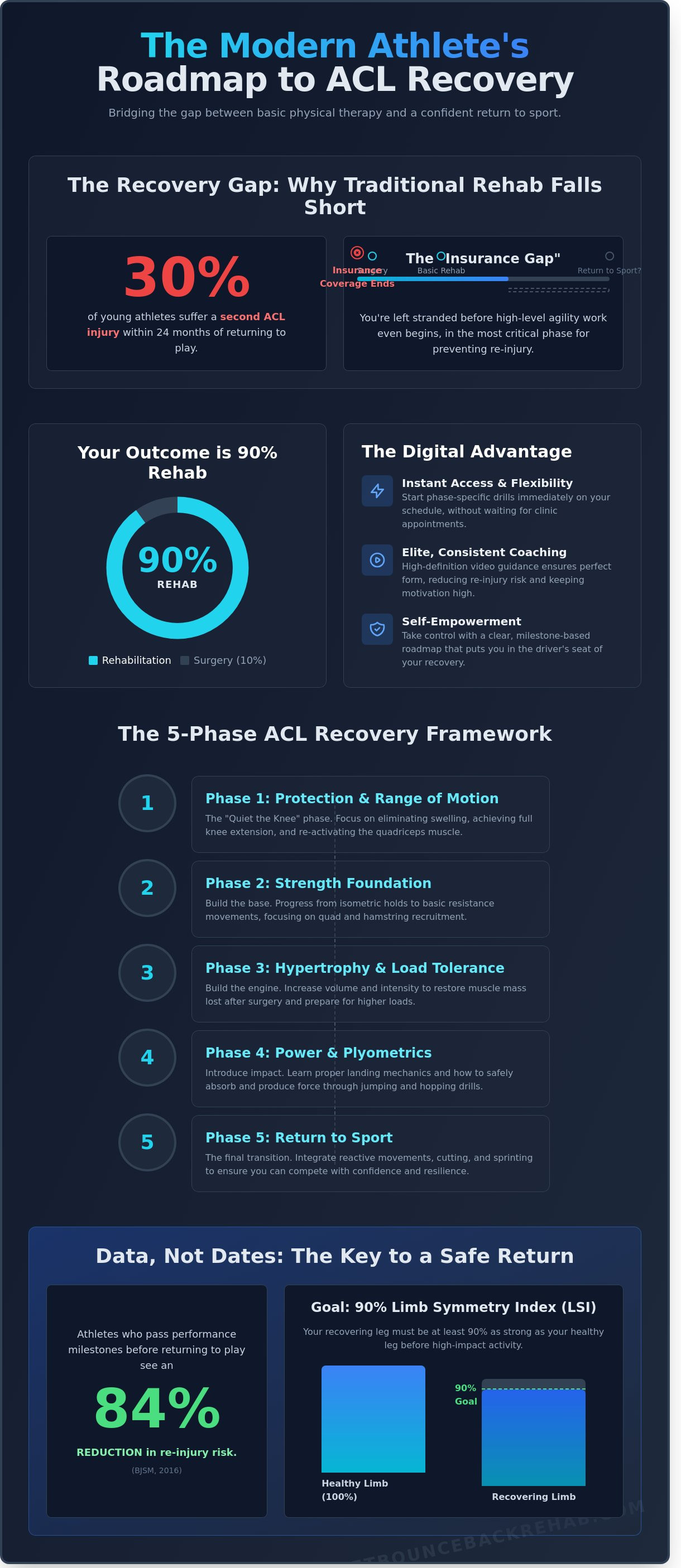
Research published in the British Journal of Sports Medicine shows that nearly 30% of young athletes under age 20 suffer a second ACL injury within 24 months of returning to play. This staggering number often stems from a healthcare system that cuts off insurance coverage after just 15 or 20 sessions, leaving you stranded before you've even started high-impact agility work. You know the feeling of being stuck in a "cookie-cutter" routine at a local clinic, performing the same basic leg lifts while your anxiety about a re-tear grows every time you think about the field. It’s frustrating to feel like your recovery has hit a ceiling just because a bureaucrat decided you were "functional" enough.
We agree that you deserve more than just getting back to walking; you deserve to thrive and reclaim the activities you love. This guide shows you how a structured online ACL rehab program bridges the gap between basic clinical care and elite sports performance. By using movement as medicine and following objective, milestone-based data, you can build the resilience needed for peak performance. We’ll walk you through a comprehensive phase-by-phase plan that replaces guesswork with sports science, giving you the tools to bounce back stronger than ever before.
Key Takeaways
Learn how to bridge the "insurance gap" by using a structured digital approach that ensures your recovery continues long after traditional clinical therapy ends.
Master a proven 5-phase roadmap designed to take you from initial range-of-motion goals to high-level athletic power and agility.
Discover how an online ACL rehab program provides elite-level coaching and cost-effective flexibility while maintaining strict safety standards.
Identify the specific performance milestones, such as the 90% Limb Symmetry Index, required to validate your readiness for a safe return to sport.
Find out how to choose a milestone-based protocol that empowers you to reclaim your lifestyle and bounce back with total confidence.
Table of Contents What is an Online ACL Rehab Program and Why Athletes are Switching? The 5-Phase ACL Recovery Framework: A Milestone-Based Roadmap Online vs. In-Person Rehab: Which Path is Right for You? Key Performance Milestones: Testing Your Readiness for Sport Bounceback into Action: Choosing the Right Digital ACL Program
What is an Online ACL Rehab Program and Why Athletes are Switching?
You’ve likely spent weeks researching your specific surgical options. While an Anterior Cruciate Ligament (ACL) reconstruction is a vital first step, the surgery only accounts for about 10% of your total recovery outcome. The remaining 90% depends on how you move, load, and train in the months that follow. An online ACL rehab program bridges this gap by providing a structured, video-guided protocol that you can access from your home or local gym.
Athletes are moving away from traditional models because of the "Insurance Gap." Most insurance providers stop covering visits once you achieve basic daily functions, like walking or climbing stairs. This leaves you stranded during the final 30% of your recovery, which is exactly when you need high-level plyometric and agility training to prevent re-injury. We believe in movement as medicine, turning your recovery into an opportunity to build a more resilient body than you had before the injury.
Instant Access: Get phase-specific drills immediately without the typical 14-day wait for a clinic opening.
Self-Empowerment: Take control of your recovery with a roadmap that puts you in the driver's seat of your own progress.
Consistent Coaching: High-energy guidance keeps your motivation high during the difficult "grind" months of mid-stage rehab.
The Problem with Generic Physical Therapy
If you're a soccer player aiming to get back on the pitch, "three sets of ten" of basic leg lifts won't cut it. Many traditional clinics operate on a high-volume model where one therapist manages 4 patients at the same time. This diluted attention often leads to a "one size fits all" approach that ignores the specific biomechanics of your sport. Clinical stagnation is the point where your physical progress plateaus because your rehab lacks the sport-specific loading and progressive intensity required for a safe return to play.
The Digital Advantage: Elite Care Anywhere
Switching to an online ACL rehab program gives you 24/7 access to elite-level expertise that was once reserved for professional athletes. These platforms use high-definition video demonstrations to ensure your form is perfect, which is critical for reducing re-injury risk. You get to master functional movement drills on your own schedule, ensuring that every jump, cut, and sprint is executed with clinical precision. It's time to reclaim your lifestyle and bounce back stronger than ever.
The 5-Phase ACL Recovery Framework: A Milestone-Based Roadmap
Recovery isn't a straight line; it's a series of earned victories. Your online ACL rehab program must guide you through five distinct stages to ensure your knee is ready for the demands of your lifestyle. Each phase serves a specific purpose, moving you from post-op protection to peak performance.
Phase 1: Protection and Range of Motion. We call this the "Quiet the Knee" phase. The goal is to eliminate swelling, achieve full terminal knee extension, and wake up the quadriceps.
Phase 2: Strength Foundation. Once the swelling subsides, we focus on quad and hamstring recruitment. You'll move from isometric holds to basic resistance movements.
Phase 3: Hypertrophy and Load Tolerance. This is where you build the engine. We increase volume and intensity to restore muscle mass that often withers after surgery.
Phase 4: Power and Plyometrics. Here, we introduce impact. You'll learn proper landing mechanics and how to absorb force safely through your joints.
Phase 5: Return to Sport. The final transition involves reactive movements, cutting, and sprinting. This phase ensures you're not just moving, but competing with confidence.
Why Criteria-Based Progression Beats Time-Based Timelines
Checking a calendar doesn't tell us if your knee is stable. A 2016 study published in the British Journal of Sports Medicine revealed that athletes who passed specific clinical criteria reduced their re-injury risk by 84%. Reaching the 6-month mark post-op means nothing if your quad strength is only 50% of the healthy side. You need a 90% limb symmetry index before moving into high-impact activities. To transition from Phase 2 to Phase 3, you must demonstrate full extension, minimal swelling after exercise, and a pain score below 3 out of 10 during loading. This data-driven approach ensures you bounce back with total confidence rather than crossing your fingers.
The Science of Neuromuscular Re-education
Injury disrupts the neural pathways between your brain and your muscles. Modern digital programs use specific drills to "re-wire" this connection, ensuring your brain trusts your knee again. We emphasize eccentric loading during the middle phases of rehab. By focusing on the lowering phase of a movement, you build the deceleration capacity required to prevent future non-contact tears. This isn't just about lifting weights; it's about teaching your nervous system to stabilize your joint under pressure. You'll use visual cues and varied tempos to unlock your body's natural resilience and restore fluid, athletic movement.
Online vs. In-Person Rehab: Which Path is Right for You?
You face a critical choice at the start of your recovery. One path involves driving to a clinic three times a week for standard care; the other empowers you with the tools to dominate your recovery from any gym in the world. Choosing an online ACL rehab program isn't just a matter of convenience. It's a strategic decision to prioritize high-performance outcomes over basic maintenance.
The financial math is clear. Traditional physical therapy co-pays typically range from $30 to $75 per session. Over a standard nine-month recovery timeline with two sessions per week, your out-of-pocket costs can quickly climb to $2,700 or more. A comprehensive digital program usually costs less than 15% of that total. This allows you to invest your resources into better gym equipment or high-quality nutrition to support your healing.
Safety is our foundation. You should see a local clinician during the first 14 days after surgery to monitor your incision and ensure you achieve 0 degrees of knee extension. Once those clinical milestones are met, your progress depends on consistent, heavy loading. Many athletes find success with a hybrid model. They use an online ACL rehab program for their daily training while visiting a local therapist once a month for objective strength testing. Bounceback serves as your dedicated ally in this journey, providing the expert coaching and movement as medicine you need to reclaim your lifestyle.
Breaking the "Manual Therapy" Myth
Many traditional clinics rely heavily on passive treatments like ultrasound or massage. While these might feel temporary relief, they don't build the quad strength required to protect your graft. Evidence from the British Journal of Sports Medicine shows that active loading is 10 times more effective for long-term success than passive modalities. We focus on progressive overload. This method ensures your muscles and tendons adapt to increasing stress, which is the only way to truly bounce back to peak performance.
Autonomy and Resilience in Recovery
Owning your recovery process transforms your psychology. When you follow a structured digital protocol, you shift from being a passive patient to an empowered athlete. This autonomy builds the resilience needed for sports. You learn the biomechanics of your own movement, which reduces the risk of future injury. This ownership ensures that when you return to the activities you love, you do so with a mindset that is as strong as your new ACL.
Key Performance Milestones: Testing Your Readiness for Sport
You’ve put in the hard work, but time alone doesn't clear you for the field. Your recovery is fueled by data, not just the calendar. To ensure you're ready to thrive, we focus heavily on the Limb Symmetry Index (LSI). The LSI is a percentage comparison of your surgical leg to your healthy leg, where a 90% score or higher is the non-negotiable benchmark for safe pivoting and cutting. Research indicates that athletes who return to sport with less than 90% symmetry are 4 times more likely to suffer a subsequent knee injury.
Balance is just as vital as raw power. We monitor your Quad-to-Hamstring Ratio to ensure your knee remains stable under pressure. Ideally, your hamstrings should produce at least 60% of the force of your quadriceps to protect the graft during high-speed deceleration. You'll also complete a battery of hop tests, such as the single hop for distance and the triple crossover hop. These tests measure both physical power and your internal confidence. If you score below 60 on the ACL-RSI (ACL Return to Sport After Injury) scale, you might have the physical strength but lack the mental "green light" needed to compete without hesitation.
Objective Strength Testing at Home
A high-quality online ACL rehab program empowers you to track these metrics using basic gym equipment. You can use a single-leg leg press or even bodyweight benchmarks like the single-leg squat to failure to measure progress. The Limb Symmetry Index is defined as the score of the involved limb divided by the score of the uninvolved limb multiplied by 100, and hitting that 90% mark is your ticket to the next phase of performance. This objective data removes the guesswork from your journey and builds your resilience.
Landing Mechanics and Deceleration
Speed is impressive, but your ability to stop safely is what prevents reinjury. We focus on deceleration because approximately 70% of ACL tears occur during non-contact landing or cutting maneuvers. Modern online ACL rehab program options utilize "snap-down" drills and vertical-to-lateral box landings to retrain your nervous system. These drills teach you to absorb force through your hips and glutes rather than your knee joint. Mastering these landing patterns ensures your "new" knee can handle the chaotic environment of a live game.
Ready to see if your metrics hit the mark? Join our community and start your personalized online ACL rehab program today to unlock your peak performance.
Bounceback into Action: Choosing the Right Digital ACL Program
Choosing an online ACL rehab program is the most critical decision you'll make after your injury. You shouldn't settle for a generic list of exercises or static PDFs. A truly effective digital protocol must offer phase-specific video guidance that evolves as your strength improves. You need a system that tracks your progress against objective milestones, such as achieving 90% limb symmetry before you clear yourself for high-impact pivoting. At Bounceback, our protocols are designed by sports physical therapists who have spent over 15 years training elite athletes to return to the field stronger than they were before their tear.
We focus heavily on the needs of younger players through our specialized "Youth Sports" approach. Growing athletes have unique biomechanical requirements and open growth plates that demand a tailored recovery path. We don't just fix a knee; we build a resilient foundation for a long athletic career. Our program ensures that every jump, land, and cut is coached with clinical precision to minimize the 20% re-injury risk often seen in younger populations.
The Bounceback Difference: Beyond the Exercises
We don't believe in clinical, sterile routines that feel like a chore. Our platform integrates a high-energy coaching style that brings the atmosphere of a pro-level training facility directly to your living room. You won't just follow a screen; you'll feel the motivation of a dedicated ally in your corner. Parents can find specialized support through our Youth Sports Injury Recovery App, which simplifies the recovery process for busy families. Plus, our lifetime access feature means you'll have these tools for years, providing a permanent resource for injury prevention and peak performance maintenance.
Your First 24 Hours: Starting the Protocol
Your comeback starts the moment you decide to take action. Gaining access to the Bounceback protocol is immediate, allowing you to begin the "Prehab" or "Early Post-Op" phase within minutes. These initial 24 hours are vital for managing inflammation and restoring early range of motion. Our streamlined onboarding gets you moving right away so you can stop worrying about the "what ifs" and start focusing on the "what's next." It's time to reclaim your lifestyle and move without fear. Unlock your peak performance with the Bounceback ACL Program and start your Phase 1 protocol today.
Take Control of Your Comeback Today
You now have the roadmap to move from post-op frustration to high-level athletic performance. Recovery isn't a waiting game; it's a deliberate 5-phase process built on objective milestones and functional testing. By choosing a comprehensive online ACL rehab program, you eliminate the 14-day average wait for specialist appointments and start using movement as medicine immediately. Our protocol, crafted by board-certified Sports Physical Therapists, provides phase-specific video coaching for all 5 stages of your recovery. This ensures your biomechanics are optimized for every single rep, whether you're regaining terminal knee extension or hitting your 90% limb symmetry index for return-to-play. You've seen how digital access provides the tools to rebuild your strength and resilience on your own schedule. Don't let your injury define your future when elite-level expertise is available at your fingertips. Your journey toward peak performance starts with a single, confident step forward. We're ready to help you reclaim the lifestyle you love. You've got the grit to succeed, and we've got the clinical expertise to guide you home.
Frequently Asked Questions
Is an online ACL rehab program safe to do without a doctor present?
Yes, an online ACL rehab program is safe when it follows evidence-based clinical protocols and provides clear video demonstrations for every movement. Most traditional recovery involves performing 85% of your exercises at home anyway. Our digital platform acts as your dedicated ally, ensuring your biomechanics remain precise. You'll have access to 24/7 support to ensure you stay on the path to peak performance without needing a therapist physically standing over you.
Can I use an online program if I decided not to have ACL surgery?
You can absolutely use a digital program if you choose the non-surgical coper route. Data from the British Journal of Sports Medicine shows that 40% of patients achieve stable knee function through high-quality conservative management. We focus on building incredible quad strength and neuromuscular control to unlock your stability. This approach treats movement as medicine, helping you thrive and return to the activities you love without undergoing a reconstruction.
How much does a typical online ACL rehab program cost compared to PT?
A typical online ACL rehab program costs between $200 and $500 for full lifetime access, while traditional in-person physical therapy often runs $150 per session. Over a 9-month recovery period, you might save over $3,500 in co-pays and travel expenses. This investment gives you elite-level coaching at a fraction of the price. You get the same clinical precision and structured path toward your goals while maintaining total control over your recovery budget.
What equipment do I need to follow a digital ACL protocol at home?
You only need a few essential tools like a set of 5 resistance bands, a sturdy 18-inch box or bench, and a pair of dumbbells to complete the protocol. Most of our athletes start with just their body weight during the first 4 weeks. As you progress, you'll use these simple tools to challenge your functional movement and build resilience. This setup allows you to transform any space into a high-performance clinic where you can bounce back.
How do I know if I am ready to move to the next phase of the program?
You move to the next phase once you clear specific objective benchmarks, such as achieving a 90% limb symmetry index on strength tests. We don't guess; we measure your progress through functional assessments like the single-leg hop test. If your knee shows zero swelling and you have full range of motion, you've unlocked the next level. This structured progression ensures you never rush, keeping your recovery steady, purposeful, and highly organized.
Can an online program help with youth sports injuries specifically?
Digital programs are highly effective for youth athletes, especially since 1 in 50 female high school athletes will suffer an ACL tear. We tailor the coaching cues to be high-energy and engaging for younger players. The program emphasizes plyometric landing mechanics to prevent future injuries. By following this digital protocol, young athletes develop the discipline and resilience needed to return to the field better than they were before their injury occurred.
What happens if I feel pain while doing the exercises in the app?
If you feel pain, follow the 3/10 rule: any discomfort should stay below a 3 on a 10-point scale and disappear within 24 hours. Some soreness is normal as we push your biomechanics, but sharp or increasing pain is a signal to scale back. Our app includes a messaging feature so you can consult your therapist ally immediately. We'll help you adjust your form to ensure your movement remains an empowering tool for self-improvement.
How long does the full ACL rehab program take to complete?
A comprehensive recovery typically takes 9 to 12 months to ensure your graft is fully mature and your strength is restored. Research indicates that returning to sports before the 9-month mark increases your re-injury risk by 7 fold. We guide you through every day of this journey, from the initial post-op swelling to your first full-speed pivot. This timeline isn't a limitation; it's the necessary runway for you to truly bounce back and thrive.


Comments