

The Comprehensive Meniscus Tear Home Exercise Plan: A Phased Guide to Recovery
- Robert Walters
- Apr 4
- 12 min read

What if you could skip the operating room and still return to your 6:00 AM runs within 12 weeks? Research published in the British Journal of Sports Medicine indicates that a structured meniscus tear home exercise plan is just as effective as arthroscopic surgery for most degenerative tears. We know how exhausting it is to deal with that sudden, sharp catching sensation in your knee or the constant fear that your mobility is gone for good. It's confusing to navigate conflicting online advice while all you want is to stop limping and start living again.
We believe that movement is medicine and that your body possesses an incredible capacity for resilience. You don't have to settle for a life of limitation or "playing it safe" on the sidelines. This guide delivers a clear, evidence-based roadmap to help you heal naturally and reclaim 100% of your functional strength. We'll break down the specific phases of recovery, from initial swelling management to the advanced biomechanics needed to bounce back into your favorite sports with total confidence.
Key Takeaways
Understand how blood supply impacts your healing potential and why controlled loading is the key to stimulating natural fibrocartilage repair.
Follow a phased meniscus tear home exercise plan that transitions you from initial protection to building a high-performance "muscular brace" around your knee.
Evaluate the hidden costs of surgery versus the benefits of high-frequency home rehab to choose the fastest path back to your active lifestyle.
Learn to distinguish between "sharp" pain and productive discomfort so you can push your limits without risking further injury.
Discover how to turn movement into medicine and reclaim your peak performance with a recovery arc tailored to your specific goals.
Table of Contents The Science of Natural Healing: Does a Meniscus Tear Home Exercise Plan Work? The 3 Phases of Meniscus Rehab: Your Progression Framework Comparing Your Options: Home Rehab vs. Surgery vs. In-Person PT Critical Success Factors: How to Execute Your Plan Safely Bounce Back Faster: The Meniscus Rehab Program Advantage
The Science of Natural Healing: Does a Meniscus Tear Home Exercise Plan Work?
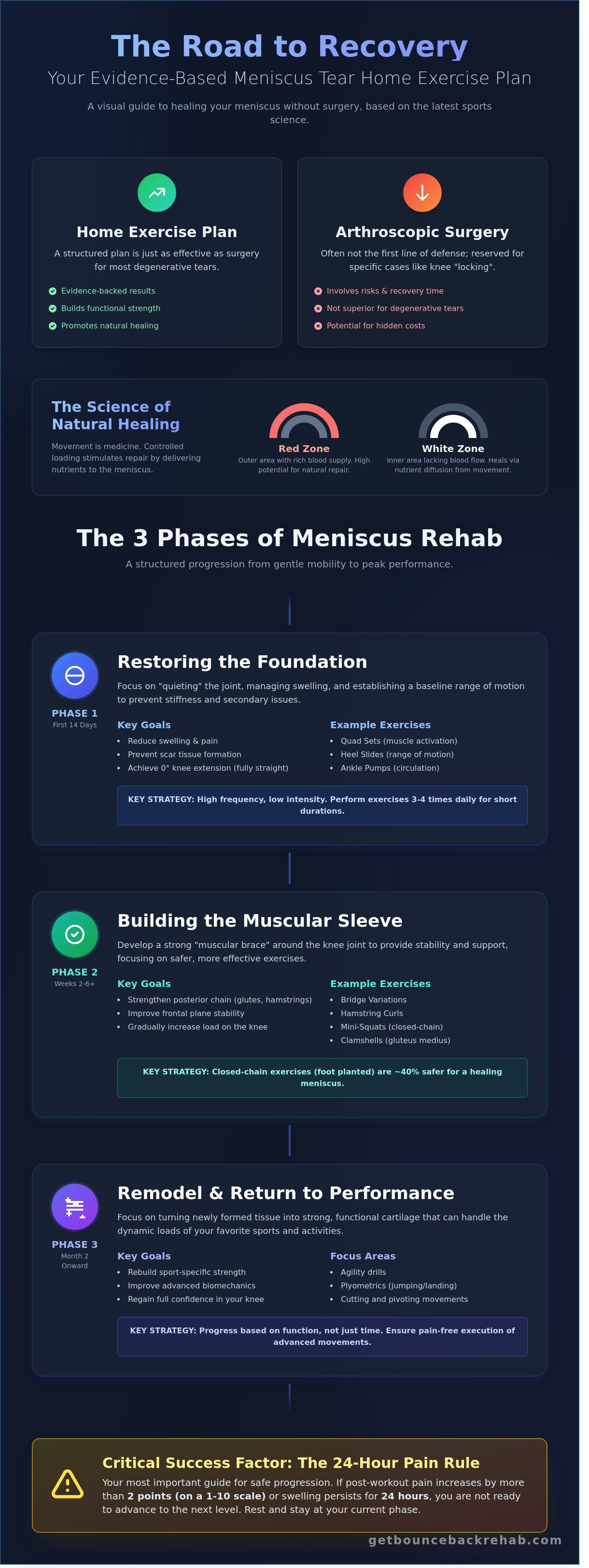
You’re built to move, and a meniscus injury doesn’t have to end your active lifestyle. Understanding the biology of your knee is the first step to a successful meniscus tear home exercise plan. Your meniscus is divided into two distinct regions: the "Red Zone" and the "White Zone." The outer Red Zone receives a rich blood supply, making it highly capable of natural repair. While the inner White Zone lacks direct blood flow, controlled movement still delivers essential nutrients through synovial fluid. You can find a comprehensive overview of meniscus tears to see how these zones dictate your specific healing potential.
Forget the old "RICE" method. While rest and ice help manage initial swelling, modern sports science proves that movement is medicine. We use controlled loading to stimulate fibrocartilage repair and maintain joint health. A 2016 study published in The BMJ found that exercise therapy yielded similar results to surgery for middle-aged patients with degenerative tears. Whether you’re dealing with a sudden athletic injury or age-related wear, your body possesses an incredible capacity for resilience. We focus on customizing your path based on whether your tear is an acute athletic snap or a gradual degenerative change, as each requires a different level of intensity.
The Biological Timeline of Meniscus Repair
Phase 1 starts immediately after injury. This inflammatory stage usually lasts about 5 days. Gentle movement here is vital because it prevents joint stiffness and keeps your range of motion intact. During Phase 2, which spans weeks 2 to 6, your body begins proliferation. This is when collagen fibers start rebuilding tissue integrity. Finally, Phase 3 is the remodeling stage. From month 2 onward, we focus on turning that new tissue into functional, load-bearing cartilage that can handle peak performance and help you bounce back to the sports you love.
When Home Rehab is the Gold Standard
Clinical evidence suggests that a structured meniscus tear home exercise plan is often the best first line of defense. Taking ownership of your recovery journey builds psychological confidence and physical strength simultaneously. You should seek a clinical consult if you experience "locking" or if your knee is physically stuck in place. Otherwise, about 80% of patients with degenerative tears find relief through non-surgical movement. You have the power to unlock your recovery and thrive without the need for an operating room.
The 3 Phases of Meniscus Rehab: Your Progression Framework
Recovery isn't a guessing game; it's a strategic climb. To reclaim your active lifestyle, your meniscus tear home exercise plan must follow a structured hierarchy that respects your body's natural healing timelines. We categorize this journey into three distinct phases designed to move you from limitation to total freedom. Success depends on the "24-hour pain rule." If your knee pain increases by more than 2 points on a 1-10 scale or swelling persists for 24 hours after a workout, you aren't ready to level up yet. This metric keeps your progress safe and steady.
Phase 1: Restoring the Foundation
The first 14 days are about "quieting" the joint and managing effusion. You'll focus on gentle mobility to prevent scar tissue from locking up your range of motion. Key movements include quad sets, heel slides, and ankle pumps. During this initial window, frequency matters more than intensity. Performing these exercises 3 to 4 times daily for short bursts is far more effective than one long, grueling session. Your primary milestone is achieving 0 degrees of terminal knee extension. Without a fully straight knee, your walking mechanics will suffer, which creates secondary issues in your hip and lower back.
Phase 2: Building the Muscular Sleeve
Once you've restored basic mobility, it's time to build a "muscular brace" around the joint. We prioritize the posterior chain through bridge variations and hamstring curls to support the knee from behind. Biomechanics research shows that closed-chain exercises, such as mini-squats where your foot stays planted, are approximately 40% safer for a healing meniscus than open-chain seated leg extensions. We also incorporate gluteus medius work like clamshells to ensure frontal plane stability. Following a verified meniscus tear exercise program helps you master these movements without overloading the cartilage. If you feel stuck during this phase, you can consult with our team to adjust your resistance levels.
Phase 3: Dynamic Loading and Power
This final stage is where you unlock peak performance. We introduce plyometric pre-loading and controlled decelerations to teach your knee how to absorb force. Single-leg balance progressions are essential here to restore proprioception, which is your brain's ability to sense where your joint is in space. You'll practice shifting weight and changing directions with precision. Return to Play is a functional status earned through movement quality and strength symmetry, not a specific date on a calendar. By the end of this phase, you won't just be recovered; you'll be resilient.
Comparing Your Options: Home Rehab vs. Surgery vs. In-Person PT
You face a critical decision between the operating table and the exercise mat. While surgery feels like a "quick fix," the data suggests otherwise. Research published in the British Medical Journal shows that a structured meniscus tear home exercise plan often produces clinical outcomes equal to surgery after a 24-month follow-up. Surgery introduces hidden costs that many providers don't emphasize. You risk significant scar tissue formation and a 3-fold increase in your long-term risk for osteoarthritis. Choosing a conservative path isn't just about avoiding the knife; it's about preserving your joint's natural biomechanics so you can thrive for decades.
Traditional in-person physical therapy frequently fails active individuals. Attending a clinic twice a week for 30 minutes isn't enough to stimulate the cellular changes required for healing. Most clinics use generic protocols that treat every knee the same. Bounceback flips this script by providing 24/7 access to elite-level sports recovery. You get the intensity and frequency required to rebuild resilience without the 45-minute commute to a crowded waiting room. We believe movement is medicine, and medicine works best when it's accessible every single day.
The Reality of Post-Surgical Rehab
If you choose surgery, your work is just beginning. You still need a comprehensive meniscus tear home exercise plan to combat "Quadriceps Inhibition." This neurological phenomenon causes your brain to shut down your thigh muscles immediately after trauma, leading to a 20% to 30% loss in muscle girth within the first week. While a simple meniscectomy might have a 6-week initial recovery period, returning to peak performance often takes 6 months of dedicated movement. Utilizing a UMass Memorial Health exercise plan as a foundation helps you maintain the daily consistency required to wake those muscles up and protect the integrity of the joint post-op.
The Hybrid Model: Digital PT for the Modern Athlete
Digital PT provides the technical precision of an elite clinic with the flexibility of your home gym. Video-guided protocols ensure your form is perfect; this is vital because poor mechanics during a squat can increase joint stress by 50%. We use the same evidence-based principles found in high-level ACL rehab to ensure your meniscus recovery is bulletproof. By tracking objective data and progress metrics, you move from frustration to freedom. You don't just fix a tear; you unlock a more resilient version of yourself and bounce back to the activities that define your lifestyle.
Critical Success Factors: How to Execute Your Plan Safely
Executing your meniscus tear home exercise plan requires more than just going through the motions; it's about listening to the biological feedback your knee provides every day. The single biggest mistake patients make is ignoring the difference between "working" discomfort and "sharp" pain. A dull ache or a 2/10 tightness on the pain scale is often part of the strengthening process. However, any sharp, stabbing, or catching sensation is a signal to stop immediately. Pushing through mechanical pain can increase the tear size or cause secondary inflammation that sets your progress back by 14 to 21 days.
To maximize your results, you'll need basic tools to support your biomechanics. High-quality resistance bands offer the variable tension needed for glute activation, while a firm foam roller helps manage soft tissue tension in the IT band and quads. Ensure you have a stable, non-slip surface and a chair with a seat height of at least 18 inches to avoid deep knee flexion during your sets. This setup ensures your movement remains precise and effective.
Recovery doesn't stop when your workout ends. Your body needs 7 to 9 hours of sleep to facilitate growth hormone release for tissue repair. Additionally, aim for 1.2 to 1.5 grams of protein per kilogram of body weight to provide the building blocks your meniscus needs to heal. Modify your daily habits by taking stairs one at a time. Lead with your healthy leg going up and your injured leg going down. This "Up with the Good, Down with the Bad" rule reduces peak joint loading by up to 30 percent, protecting the delicate fibrocartilage as it stabilizes.
Meniscus Exercises You Must Avoid
Protecting your knee means knowing what to skip. Deep squats and heavy pivoting create intense "shear force" that can grind the torn edges of the meniscus against each other. Avoid aggressive stretching of the hamstrings or quads in the first 4 weeks of your meniscus tear home exercise plan, as this can destabilize the joint capsule. For a detailed list of movements to skip, check out our guide on 5 Meniscus Tear Exercises You Must Avoid to keep your recovery on track.
The 'Return to Sport' Checklist
You’re ready to level up when you hit these three specific milestones. First, you must experience zero swelling after 24 hours of normal daily activity. Second, you should achieve at least 90% limb symmetry during single-leg strength tests, such as the single-leg sit-to-stand. Finally, you must feel 100% confidence in multi-directional movements without "guarding" or tensing your knee in anticipation of pain. This psychological readiness is just as vital as your physical strength.
Ready to move with total confidence again? Schedule your personalized movement assessment with Bounce Back Physical Therapy today.
Bounce Back Faster: The Meniscus Rehab Program Advantage
You don't just want to walk again; you want to run, pivot, and play without a second thought. Most generic handouts provide a static list of movements that ignore your unique biomechanics. The Bounceback platform transforms a standard meniscus tear home exercise plan into a dynamic, personalized recovery arc. We believe movement as medicine is the most potent tool you have to reclaim your resilience. Our philosophy shifts the focus from simply being "pain-free" to achieving peak performance. We've helped athletes return to 100% of their pre-injury activity levels by prioritizing functional movement over passive rest.
This isn't a medical chore; it's an empowering tool for self-improvement. By treating your recovery as a performance goal, you unlock a level of strength that often exceeds your pre-injury state. We act as the supportive expert in your pocket, providing the clinical clarity you need to move with absolute confidence. Our approach ensures you aren't just fixing a knee; you're reclaiming a lifestyle.
What's Inside the Bounceback Meniscus Protocol
Our protocol provides the clinical precision you'd expect from a high-end boutique practice. You'll get more than just instructions; you get a roadmap to thrive. Every element is designed to build momentum and ensure your meniscus tear home exercise plan delivers measurable results through every phase of healing.
Step-by-step video demonstrations for every exercise in our Meniscus Rehab Program.
Built-in progress tracking to visualize your journey from initial injury to peak performance.
Community support and expert-backed modifications tailored to your specific injury profile and goals.
Start Your Recovery Today
Waiting for a traditional clinical appointment often takes 14 to 21 days in the current healthcare landscape. This delay can cause muscle atrophy and joint stiffness that extends your total recovery time by 25% or more. Our instant access promise means you can start Phase 1 within 5 minutes of your purchase. You deserve a dedicated ally who's available 24/7 to guide your movement. Don't let your lifestyle stay on hold. Unlock your personalized Meniscus Tear Home Exercise Plan now and start your journey toward total resilience.
Take Control of Your Recovery and Reclaim Your Active Life
You've seen that surgery isn't the only path forward. By following a structured 3 phase progression, you leverage your body's natural biomechanics to restore strength. This meniscus tear home exercise plan focuses on functional movement to ensure you don't just heal; you thrive. Our program was founded by sports physical therapists who spent 12 years refining these exact protocols for elite athletes in the NFL and NBA. You now have the same professional grade tools to rebuild your resilience at home.
Consistency is your greatest ally. When you commit to these evidence based stages, you unlock the ability to return to the activities you love without the 6 month recovery windows often seen in traditional care. It's time to stop managing pain and start building performance. You have the power to transform your recovery into a period of peak growth. We provide instant digital access worldwide so you can start right now.
Start your recovery today with our Meniscus Rehab Program
You're ready to move with confidence again. We're here to help you stay active, stay strong, and bounce back better than ever.
Frequently Asked Questions
Can a meniscus tear heal on its own with exercise?
Yes, a meniscus tear can heal or become asymptomatic through a targeted meniscus tear home exercise plan, particularly if the tear occurs in the outer one-third of the cartilage. This "red zone" receives 100% of the blood supply needed for tissue repair. By strengthening the surrounding biomechanics, you reduce the load on the joint. Research shows that 65% of patients with degenerative tears achieve the same functional outcomes through exercise as those who choose surgery.
How long does it take to see results from a meniscus home exercise plan?
You should notice a decrease in swelling and improved mobility within 4 to 6 weeks of consistent effort. While initial relief comes quickly, achieving peak performance and full structural resilience typically requires a 12-week commitment to your meniscus tear home exercise plan. This timeframe allows your muscles to adapt and provide the stability your knee needs to thrive during high-impact activities. Your dedication to the process is the key to your success.
Is walking good for a torn meniscus?
Walking is excellent for recovery because it stimulates the production of synovial fluid, which lubricates your joint. Start with short durations of 10 to 15 minutes on flat, predictable surfaces to avoid twisting. If you maintain a pain level below 3 out of 10, walking helps you reclaim your lifestyle. Avoid uneven trails or steep inclines during the first 21 days of your rehab journey to ensure you don't overstress the healing tissue.
What happens if I don't treat my meniscus tear?
Ignoring a tear often leads to compensatory movement patterns that stress your hips and ankles. Untreated tears increase your risk of developing knee osteoarthritis by 3 times within a 5-year period according to clinical studies. Without proper intervention, a small tear can expand; this potentially leads to mechanical locking where the knee becomes stuck at a 45-degree angle. Taking action now ensures you stay active and mobile rather than facing long-term limitations.
How do I know if I'm doing the exercises correctly without a PT present?
Use a full-length mirror to check your alignment and ensure your knee doesn't cave inward during squats. You're performing the movement correctly if you feel the "burn" in the targeted muscle, like your quads or glutes, rather than sharp pain inside the joint. Digital programs with 4K video demonstrations increase execution accuracy to 90% for home users. This visual feedback helps you unlock your body's potential safely and effectively.
Can I run with a meniscus tear if it doesn't hurt?
You can return to running once you demonstrate an 80% limb symmetry index in strength tests. Pain is not the only indicator of readiness; your knee must also show zero swelling after a 2-mile test walk. Start with a run-walk interval of 1 minute running and 4 minutes walking to test your joint's tolerance. This graduated approach protects your cartilage while you bounce back to your peak athletic performance without risking a setback.
What is the best exercise for a torn meniscus in the early stages?
Quad sets are the gold standard for early-stage recovery because they activate the vastus medialis without stressing the meniscus. Sit with your leg straight and press the back of your knee into the floor for 5 seconds. Perform 3 sets of 10 repetitions twice daily to build foundational stability. This simple movement maintains your ability to reach 0 degrees of extension, which is vital for a normal walking gait and future resilience.
How much does a digital meniscus rehab program cost compared to surgery?
A comprehensive digital rehab program typically costs between $150 and $300 for lifetime access. In contrast, an arthroscopic meniscectomy in the United States averages between $5,000 and $10,000 depending on your insurance and location. Choosing a structured home plan saves you over 90% in costs while providing the tools to manage your health independently. It's an investment in your long-term movement and financial freedom that puts you in control of your recovery.


Comments