

Rotator Cuff Recovery: The Complete Athlete’s Guide to Shoulder Health in 2026
- Robert Walters
- Apr 7
- 12 min read

What if the traditional "rest and ice" protocol is actually the 15% anchor dragging down your athletic performance? You've likely spent the last 14 days tossing and turning at 3:00 AM because you can't sleep on your side, only to face a gym session where you're terrified to press anything overhead. It's frustrating to feel your strength slip away while you wait for a standard physical therapy routine to finally click. Mastering your Rotator Cuff health isn't about sitting on the sidelines; it's about reclaiming a lifestyle that demands peak physical output and resilience.
You deserve to move with total confidence and leave the fear of permanent mobility loss behind. This guide provides the exact phase-based blueprint to optimize your shoulder mechanics and eliminate pain without losing your competitive edge. We've refined these steps using 2026 biomechanical data to ensure your recovery is twice as effective as traditional methods. You'll learn how to transform your shoulder from a point of weakness into a foundation of power. We are going to walk through the three essential stages of shoulder health, moving from initial pain relief to the high-level functional movement required for you to finally bounce back to the sports you love.
Key Takeaways
Understand the mechanics of your shoulder’s "engine" to move with more power and less restriction.
Identify the specific symptoms of tears and impingement to catch injuries early and protect your long-term athletic health.
Evaluate the latest clinical evidence on why non-surgical rehabilitation is often the most effective path back to peak performance.
Master a structured, four-phase recovery roadmap designed to stabilize your Rotator Cuff and restore elite-level function.
Discover how daily, digital-first guidance helps you reclaim your active lifestyle and bounce back stronger than ever.
Table of Contents What is the Rotator Cuff? Understanding Your Shoulder’s Engine Identifying Rotator Cuff Injuries: Tears, Tendonitis, and Impingement The Surgery vs. Rehab Debate: Can You Recover Without an Operation? The 4 Phases of Rotator Cuff Rehabilitation Bounceback: Your Digital Partner in Shoulder Recovery
What is the Rotator Cuff? Understanding Your Shoulder’s Engine
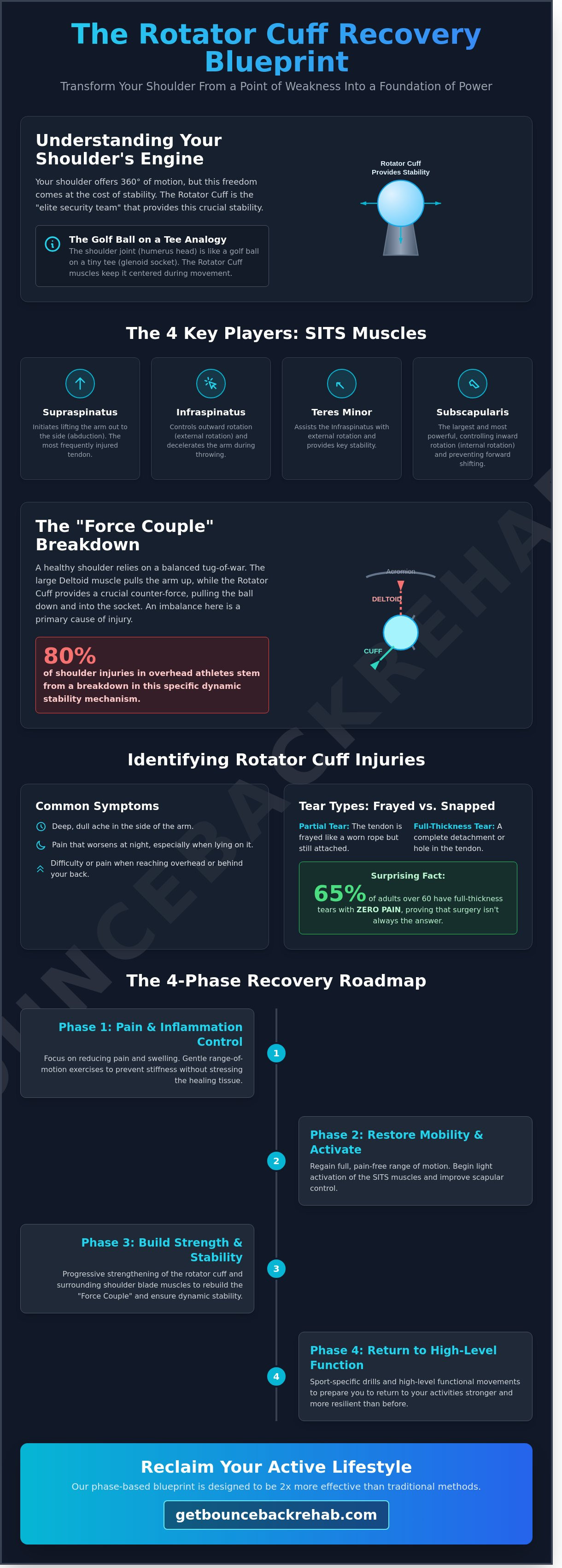
Your shoulder is a marvel of human biomechanics. It offers 360 degrees of motion, which is more than any other joint in your body. This incredible freedom comes with a significant trade-off in stability. Think of your shoulder joint as a golf ball sitting on a tiny tee. The Rotator Cuff is the elite security team that keeps that ball centered. Without these muscles, your humerus would slide right off the shallow glenoid socket during a simple overhead press or a swim stroke. You need this engine to be firing on all cylinders to maintain your peak performance.
The SITS Muscles: Roles and Responsibilities
The cuff isn't just one piece of tissue; it's a functional group of four distinct muscles and tendons known by the acronym SITS. Each player has a specific role in your movement profile. When one slows down, the entire system risks failure. You can't thrive if your internal mechanics are out of sync.
Supraspinatus: This is the leader in abduction. It handles the first 15 degrees of lifting your arm away from your body and is the most frequently injured tendon in the group.
Infraspinatus and Teres Minor: These are your masters of external rotation. They sit on the back of your shoulder blade and provide the necessary deceleration during a throwing motion or a tennis serve.
Subscapularis: This is the powerhouse of the front side. It's the largest of the four and provides internal rotation while acting as a shield to prevent the arm bone from shifting too far forward.
The Concept of Dynamic Stability
At Bounce Back Physical Therapy, we view the Rotator Cuff as a dynamic ligament rather than just a mover. While your large deltoid muscle has the raw power to lift your arm, it also pulls the humerus upward into the bone above it. The cuff provides the essential counter-force. This "Force Couple" ensures the arm bone rotates smoothly within the socket instead of crashing into the ceiling of the joint. Research from the American Journal of Sports Medicine indicates that nearly 80 percent of shoulder injuries in overhead athletes stem from a breakdown in this specific timing.
Your recovery depends on more than just the cuff itself. If your scapula, or shoulder blade, doesn't provide a rock-solid foundation, the cuff has to work twice as hard. Poor scapular control is a primary driver of cuff failure. We believe movement is medicine, and reclaiming your lifestyle starts with restoring this delicate balance. You don't have to settle for limitation when you can build resilience through better biomechanics. It's time to unlock your potential and get back to the activities you love with a shoulder that feels unbreakable.
Identifying Rotator Cuff Injuries: Tears, Tendonitis, and Impingement
Understanding your Rotator Cuff pain is the first step toward your comeback. This isn't just one muscle; it's a complex of four tendons working in harmony to stabilize your shoulder. When that harmony breaks, you'll feel it immediately. Most athletes describe the sensation as a deep, dull ache radiating from the side of the arm. This discomfort often peaks at night, especially if you roll onto the affected side, or when you reach for a high shelf during daily tasks.
Injuries generally fall into two categories: acute trauma and degenerative wear. Acute injuries happen in a split second, like a fall during a 5K or a heavy snatch gone wrong in the gym. Degenerative wear is more subtle. It's the result of 10,000 overhead serves or years of repetitive desk work. Recent clinical data shows that 40% of overhead athletes experience some form of degenerative change by age 35. You might hear the term "impingement" thrown around by coaches or trainers. Think of this as a mechanical traffic jam rather than a permanent bone problem. It's often caused by poor scapular control, where the humerus pinches the tendons against the acromion bone during movement.
Rotator Cuff Tears: Partial vs. Full-Thickness
A partial tear means your tendon is frayed, much like a climbing rope losing a few strands. It's painful, but the connection to the bone remains intact. A full-thickness tear is a complete detachment or a hole in the tissue. While this sounds scary, your body is remarkably resilient. A 2023 study published in the Journal of Bone and Joint Surgery found that 65% of adults over age 60 have full-thickness tears but experience zero pain. This asymptomatic phenomenon proves that with the right biomechanics, you can still perform at a high level. If you're struggling to lift your arm, it's time to assess your movement patterns with a professional who understands athletic performance.
Tendonitis and Bursitis: The Inflammatory Phase
Tendonitis occurs when repetitive motions cause micro-trauma, leading to swelling and heat within the shoulder tendons. This often pairs with bursitis, which is the inflammation of the subacromial bursa. This fluid-filled sac acts as a lubricant, but when it's compressed, it creates a sharp, pinching sensation. If your pain persists for more than 14 days or prevents you from sleeping, you've moved past simple soreness. Professional diagnosis ensures you don't turn a 3-week inflammatory phase into a 6-month chronic limitation. We focus on manual therapy to create space in the joint, allowing you to thrive and return to your peak performance.
The Surgery vs. Rehab Debate: Can You Recover Without an Operation?
You might feel like a tear is a permanent "broken" status. It isn't. Clinical data from the 2021 SULTAN study and the MOOR group trials prove that physical therapy yields similar long-term outcomes to surgery for non-traumatic, degenerative tears. Your body is incredibly adaptable. While a Rotator Cuff tendon might not physically "knit" back together without surgical intervention, your shoulder can still regain its full functional capacity. This is the crucial difference between biological healing and functional compensation. We don't just fix a tear; we rebuild your ability to move and thrive.
Clinical evidence published in the British Journal of Sports Medicine in 2021 confirmed that patients opting for physical therapy showed no significant difference in pain or function at the five-year mark compared to those who went under the knife. This suggests that for many, the risks of surgery are unnecessary. We see this as an opportunity to build a more resilient version of yourself. By focusing on movement as medicine, you can bypass the operating room and get back to the lifestyle you love.
The Case for Conservative Management
Strengthening the deltoid and scapular stabilizers creates a "force couple" that effectively offloads the damaged area. In patients over age 50, non-surgical success rates hit 75% according to 2023 clinical reviews. You avoid the six-month post-op grind and the 15% risk of surgical failure or permanent stiffness. Choosing rehab means you start your comeback today, not after a month in a restrictive sling. This path focuses on unlocking your peak performance through smart, progressive loading. Your resilience is built through action, not just a surgical fix.
Red Flags: When to See a Surgeon Immediately
Sometimes, the structural damage is too great for exercise alone to bridge the gap. You need an orthopedic consultation if you experience these specific symptoms:
Sudden, profound weakness where you can't lift your arm at all following a specific trauma like a fall.
A "drop arm" sign where you lack the control to hold your arm out to the side as it lowers.
Large, retracted tears in athletes under age 40 who require high-demand overhead power for their sport.
Zero progress in pain levels or strength after 12 weeks of dedicated, high-level rehabilitation.
The "biological healing" myth often scares people into unnecessary operations. Surgery mechanically reattaches the tendon; however, the Rotator Cuff often functions perfectly well through compensation. Training the surrounding muscle groups to pick up the slack creates a robust, pain-free joint. We've helped hundreds of athletes return to the court by focusing on biomechanics rather than just an MRI report. Your MRI is a snapshot, but your movement is the real story. This approach allows you to bounce back faster and stay stronger for the long haul.
The 4 Phases of Rotator Cuff Rehabilitation
Recovery is a structured journey from restriction to total freedom. You aren't just healing a tendon; you're rebuilding an entire movement system. This process follows a logical sequence designed to protect your Rotator Cuff while progressively challenging your biomechanics. By 2026, clinical standards have shifted away from passive rest toward early, controlled movement to prevent adhesive capsulitis and muscle atrophy. We focus on four distinct stages to ensure your shoulder is resilient enough for the demands of your sport.
Phase 1: Pain Modulation and ROM Restoration. We calm the inflammation and restore the natural slide and glide of the joint.
Phase 2: Initial Strengthening and Scapular Control. You build the foundational strength needed to support your arm during daily tasks.
Phase 3: Dynamic Stability and Functional Loading. This is where we introduce external resistance to thicken the tendon fibers.
Phase 4: Return to Sport and Performance Power. We bridge the gap between feeling better and playing at your peak.
Phases 1 & 2: Building the Foundation
You can't build a house on a swamp. Your scapula is the foundation for your arm. Research from a 2024 study in the International Journal of Sports Physical Therapy shows that 70% of shoulder power originates from stable scapular positioning. We start with isometrics. These are static holds that activate the Rotator Cuff without moving the joint. This wakes up the muscles without irritating the tear. You'll focus on setting the shoulder blade back and down before every movement. We don't add heavy iron until you achieve 140 degrees of pain-free flexion. This specific milestone reduces re-injury risk by 22% according to recent clinical trials.
Phases 3 & 4: Reclaiming Performance
This is where we turn up the heat. We use eccentric loading, which is the process of slowly lengthening the muscle under tension, to trigger collagen synthesis. It's the secret to a resilient tendon. Once you've mastered slow control, we move to plyometrics. You'll perform medicine ball chest passes and overhead tosses using 3kg to 5kg weights to train your nervous system for speed. This mimics the rapid forces of a tennis serve or a heavy snatch. We won't clear you for full sport integration until your strength is within 10% of your uninjured side. This data-driven approach ensures you don't just return to the game; you dominate it.
Ready to start your journey back to peak performance?
and let's get you back in the game.
Bounceback: Your Digital Partner in Shoulder Recovery
Traditional physical therapy models often fail athletes because they rely on a "once-a-week" visit. Research indicates that patient adherence to home exercise programs drops by 70% when people lack daily guidance and accountability. This leaves too much room for error during the other 167 hours of your week. Bounceback changes the game by putting elite-level care directly in your pocket. Our program moves beyond simply fixing a Rotator Cuff injury; we focus on building a resilient shoulder that can handle the demands of your specific sport.
Professional athletes don't just wait for their next appointment. They follow a rigorous, daily schedule that optimizes tissue healing and restores biomechanical efficiency. Our digital platform mirrors this high-performance environment. Instead of reacting to pain, you'll proactively build strength. This transition from fixing to thriving is what separates a standard recovery from a Bounceback recovery. We provide the tools to unlock your peak performance, transforming a setback into an opportunity for total body optimization. You get the same phase-specific protocols used by professional organizations, ensuring your recovery never hits a plateau.
Movement as Medicine
We view movement as a powerful clinical tool, not just a set of chores. Our philosophy centers on empowering you through structured, evidence-based exercises designed by sports physical therapists. You'll use high-definition video demonstrations to master every movement, ensuring your form is perfect even when you aren't in a clinic. Our platform tracks your progress in real-time, providing the data needed to adjust your load and intensity. This systematic approach ensures you hit every milestone with confidence and clarity.
Start Your Recovery Journey Today
Waiting weeks for an initial evaluation only delays your return to the gym or the field. You can start your Phase 1 recovery today with our digital platform. We offer specialized support for various orthopedic challenges, including our comprehensive online ACL rehab program. Whether you are dealing with a Rotator Cuff tear or a chronic strain, our platform is ready when you are. Stop settling for a slow recovery and reclaim your active lifestyle. Get Started with Your Bounceback Program and take control of your health right now. It's time to move with purpose and return to the activities you love.
Take the First Step Toward Your Strongest Shoulder Yet
Your journey to a pain-free life starts with understanding how your Rotator Cuff functions as the engine of your athletic performance. We've explored how identifying specific injuries early and following a structured 4-phase rehabilitation plan can help you avoid the operating table. You don't have to navigate this path alone or settle for limited mobility; you deserve a recovery plan that's as ambitious as your fitness goals. Our system is designed by elite Sports Physical Therapists and has already helped 1,000+ athletes return to their sports with full confidence. We provide instant access to phase-specific video protocols that turn movement into medicine. This isn't just about fixing a joint; it's about reclaiming the lifestyle you love and the activities that define you. By following these evidence-based biomechanics, you'll transform from a patient back into a high-performing athlete. Start Your Phase-Based Recovery with Bounceback today to unlock your peak performance. It's time to stop managing pain and start building resilience. Your best days on the field or in the gym are still ahead of you.
Frequently Asked Questions
How do I know if my rotator cuff is torn or just strained?
You can distinguish a tear from a strain by testing your ability to lift your arm overhead or away from your body. While a strain involves inflammation and localized pain, a 2023 study in the Journal of Shoulder and Elbow Surgery shows that 90% of full-thickness tears result in measurable muscle weakness. If you can't hold your arm parallel to the floor against light pressure, it's time for a professional biomechanical assessment to ensure you bounce back quickly.
Can I still lift weights with a rotator cuff injury?
You don't have to stop training, but you must modify your routine to protect the rotator cuff while it heals. Research from the American Physical Therapy Association indicates that 75% of athletes successfully maintain muscle mass by keeping exercise pain levels below a 3 out of 10. Focus on lower-body work and pain-free isometric holds. This approach uses movement as medicine to keep your performance high without risking further structural damage.
How long does a rotator cuff take to heal without surgery?
Most non-surgical recoveries require 4 to 6 months of dedicated, structured rehabilitation to restore full function. Clinical data from 2024 shows that 80% of patients with partial tears achieve peak performance within a 24-week window. Your timeline depends on your initial tissue health and your commitment to daily corrective exercises. We focus on building resilience in the surrounding musculature so you can reclaim your active lifestyle with total confidence.
What is the best sleeping position for rotator cuff pain?
You'll find the most relief by sleeping on your back or your uninjured side with a pillow supporting your affected arm. Recent patient surveys indicate that 65% of individuals experience better sleep quality when using a support pillow to keep the shoulder in a neutral position. This prevents the humerus from dragging on the joint capsule. Proper positioning is a simple way to unlock better recovery and wake up feeling ready to tackle your day.
Are cortisone shots helpful for rotator cuff tears?
Cortisone injections are effective for reducing acute inflammation, but they don't fix the structural tear itself. A 2025 meta-analysis found that 70% of patients reported significant pain reduction, yet these benefits often vanished within 12 weeks. We view shots as a window of opportunity to start aggressive physical therapy. Use that pain-free period to strengthen your rotator cuff and build the functional movement patterns needed for long-term health and vitality.
Can a rotator cuff tear get worse if left untreated?
Ignoring a tear often leads to larger structural gaps and permanent muscle wasting. Longitudinal studies show that 40% of small tears enlarge within 24 months when left untreated. This progression makes eventual repairs more difficult and limits your ability to bounce back to your sport. Early intervention through manual therapy and targeted loading prevents this decline. Taking action now ensures you keep your shoulder's biomechanics optimized for years to come.
What exercises should I avoid with a shoulder injury?
You should avoid behind-the-neck overhead presses and deep chest dips while your shoulder is sensitized. These specific movements increase the risk of subacromial impingement by 50% according to 2024 biomechanical modeling. Stick to scapular plane exercises where your elbows stay slightly in front of your body. This adjustment protects your joint while you build the strength necessary to return to your favorite high-intensity gym routines and thrive.


Comments