

Powerful Hamstring Workouts for Strength and Athletic Recovery
- Robert Walters
- Apr 9
- 13 min read

What if the secret to bulletproofing your knees isn't found in your quads, but hidden in the back of your legs? You’ve likely felt that nagging tightness during a morning run or felt a surge of anxiety before a heavy lift, fearing a repeat of a past meniscus tear. It's frustrating when your body feels like a liability rather than an asset. Integrating targeted hamstring workouts into your routine is the most effective way to bridge the gap between clinical recovery and elite performance.
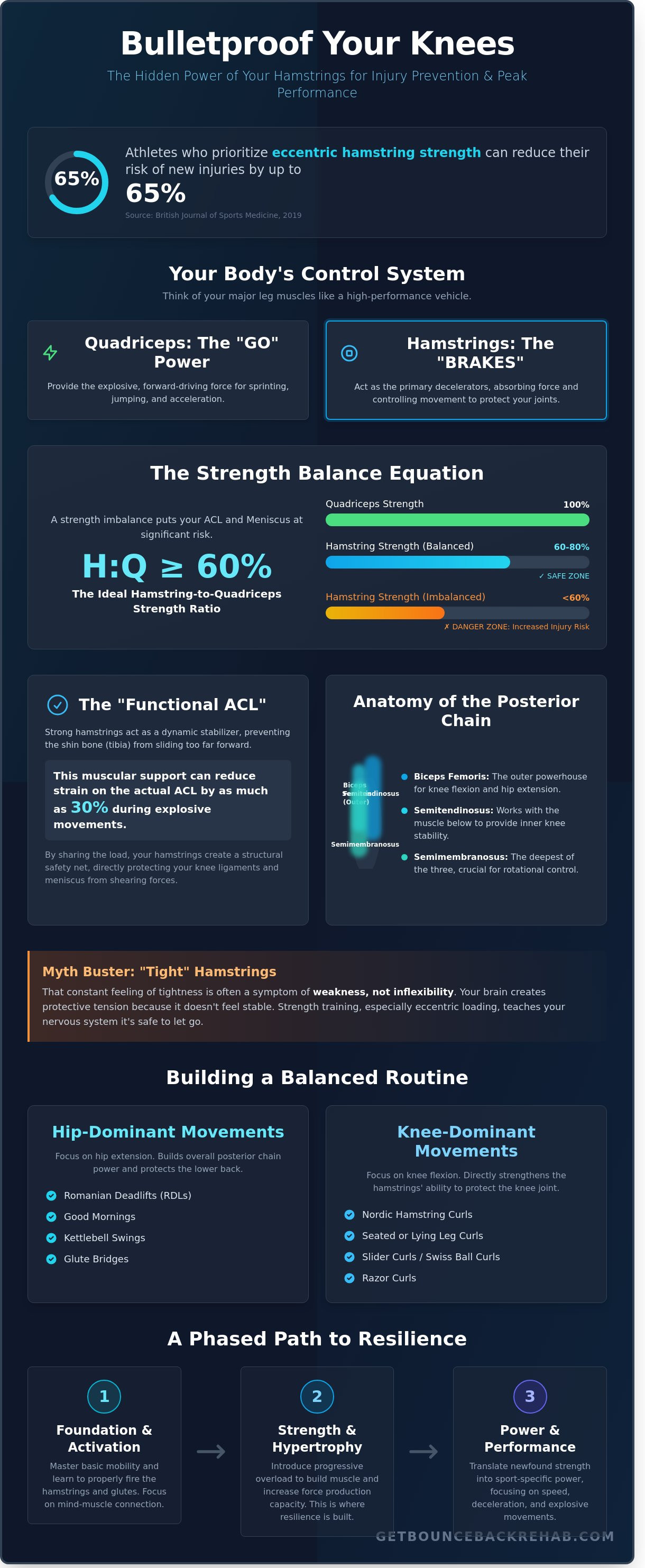
We agree that you shouldn't have to choose between playing it safe and pushing your limits. According to a 2019 study published in the British Journal of Sports Medicine, athletes who prioritize eccentric hamstring strength can reduce their risk of new injuries by 65%. This guide will help you master the mechanics of the posterior chain to build explosive power and regain total confidence in your movement. You're about to discover a structured path to unlock your athletic potential and finally bounce back to the activities you love.
Key Takeaways
Understand the "brakes" analogy of your posterior chain to transform how you decelerate and prevent injury during explosive athletic movements.
Uncover the critical link between hamstring strength and knee stability to shield your ACL and meniscus from unnecessary stress.
Learn to categorize your hamstring workouts into hip-dominant and knee-dominant movements to build a balanced, resilient foundation.
Follow a structured, phased approach to move beyond basic mobility and achieve the hypertrophy needed for long-term athletic success.
Embrace the power of active rest to fuel your posterior chain and help you bounce back to the activities you love with total confidence.
Table of Contents The Anatomy of Resilience: Why Hamstring Strength is Your Body’s Secret Weapon The Hamstring-Knee Connection: Protecting Your ACL and Meniscus The Ultimate Hamstring Exercise Roundup: Hip-Dominant vs. Knee-Dominant Building Your Routine: A Phased Approach to Hamstring Development Beyond the Workout: Integrating Recovery and Injury Prevention
The Anatomy of Resilience: Why Hamstring Strength is Your Body’s Secret Weapon
You can't drive a high-performance supercar at 200 mph if the brakes are failing. Your hamstrings are those brakes. While your quadriceps provide the "go" power, your hamstrings act as the primary decelerators during sprinting, jumping, and rapid changes of direction. Without this braking force, your knee joints lose their primary protector. Incorporating targeted hamstring workouts into your routine isn't just about building muscle; it's about installing a safety system that allows you to push your limits and reclaim the activities you love.
The Three Muscles of the Posterior Thigh
Understanding the Anatomy of the hamstring muscles is the first step toward peak performance. This complex consists of three distinct muscles. The Biceps Femoris is the outer powerhouse, vital for both knee flexion and hip extension. On the inner side, the semitendinosus and semimembranosus work in tandem to provide medial stability. The posterior chain serves as the primary engine of all athletic movement. When these three muscles work together, they create a foundation of resilience that protects you from the common strains that sideline so many athletes.
Movement as Medicine: The Functional Role
We view movement as medicine because your biomechanics dictate your quality of life. Your hamstrings play a massive role in pelvic tilting and postural alignment. When they're weak, your pelvis often tips forward, leading to a "quad-dominant" movement pattern that puts 20% more stress on your lower back and knees. A balanced body requires a specific H/Q ratio. Ideally, your hamstrings should be at least 60% as strong as your quadriceps to maintain joint integrity. If this ratio drops, your risk for ACL injuries increases significantly.
Many people come to us complaining of "tight" hamstrings. They spend hours stretching with zero results. In reality, that sensation of tightness is often a protective tension caused by weakness. Your brain tightens the muscle because it doesn't feel stable. By prioritizing hamstring workouts that focus on eccentric loading, you tell your nervous system that it's safe to let go. This shift from restriction to strength is how you truly bounce back. Consider these key functional benefits:
Hip-Hinge Synergy: Strong hamstrings allow the glutes to fire properly during a hinge, protecting the lumbar spine.
Deceleration Control: They absorb the force when you land from a jump, reducing impact on the cartilage.
Postural Correction: They help pull the pelvis into a neutral position, alleviating chronic "office chair" back pain.
At Bounce Back Physical Therapy, we don't just want you to feel better; we want you to thrive. Building a resilient posterior chain is the most effective way to transition from limitation to a life of unrestricted movement.
The Hamstring-Knee Connection: Protecting Your ACL and Meniscus
Your knee isn't just a simple hinge; it's a high-stakes pivot point that relies on a delicate balance of tension. While the Anterior Cruciate Ligament (ACL) often gets the most attention, your hamstrings are the true guardians of joint integrity. They function as a "functional ACL" by providing a mechanical brake system for your lower leg. When you perform consistent hamstring workouts, you're building a structural safety net that prevents the tibia (shin bone) from sliding too far forward relative to the femur. This forward sliding, known as anterior tibial translation, is exactly what the ACL is designed to stop. By strengthening the posterior chain, you allow the muscles to share the load, reducing the strain on the ligament by as much as 30% during explosive movements.
Weakness in this area creates a "danger zone" where the quadriceps become too dominant. This imbalance pulls the knee joint out of its optimal alignment, leading to uneven pressure on the meniscus. The meniscus acts as your knee's shock absorber, but it can only handle so much vertical force before it begins to fray or tear. Proper hamstring engagement ensures that these pads are compressed evenly, preserving your joint health for the long haul. This is why hamstring strength remains the #1 predictor of whether an athlete can successfully return to their sport after a major surgery. Without a strong back-of-leg foundation, the knee remains vulnerable to the repetitive shearing forces that cause non-contact injuries.
The Functional ACL: Anatomy of Stability
Stability is about more than just standing still; it's about controlling motion under pressure. In simple terms, your hamstrings act like a set of reins on a horse, pulling back on the tibia to keep the knee joint centered. This relationship is vital for anyone looking to avoid the grueling 9 to 12 month ACL injury length of recovery that sidelines so many dedicated athletes. By following an Evidence-Based Framework for Strengthening Exercises, you can ensure your training targets the specific fibers responsible for joint stabilization. This proactive approach transforms your legs from a liability into a resilient powerhouse, allowing you to move with total clinical confidence.
Deceleration and the Art of Landing
Most knee injuries don't happen when you're accelerating. They happen when you're trying to stop or change direction. This is the eccentric phase of movement, where your muscles must lengthen while under a heavy load. If your hamstrings aren't conditioned for this stress, your knee is likely to buckle inward during a pivot. This "valgus" collapse is responsible for approximately 70% of non-contact ACL tears. High-quality hamstring workouts prepare your nervous system to handle these sudden forces, "pre-habing" your joints for the demands of the field or court. There's a massive psychological benefit to this strength as well. When you know your legs can handle a hard landing, you play faster and more aggressively. If you want to stop worrying about your knees and start focusing on your performance, it's time to bounce back to peak movement with a targeted strength strategy.
The Ultimate Hamstring Exercise Roundup: Hip-Dominant vs. Knee-Dominant
To build true resilience, you must understand how your body moves. Your hamstrings are biarticular, meaning they cross both the hip and the knee joints. Effective hamstring workouts must target both functions to unlock your full athletic potential. By categorizing your training into hip-dominant and knee-dominant movements, you ensure every fiber of the posterior chain is engaged for both explosive power and long-term protection. This dual approach is the secret to moving from a state of limitation to peak performance.
Top Hip-Dominant Exercises for Power
Hip-dominant movements focus on the "hinge" pattern. These exercises are vital for developing the glute-ham tie-in and explosive speed. The Romanian Deadlift (RDL) remains the gold standard for building muscle length and eccentric strength. In a 2018 study, ACE research on effective hamstring exercises found that the RDL is among the most effective movements for eliciting high levels of muscle activation. Kettlebell swings complement this by teaching your body to produce power through a rapid posterior chain snap. To address side-to-side imbalances, incorporate single-leg RDLs. These unilateral moves improve your proprioception, ensuring you stay stable and balanced during high-intensity activities.
Top Knee-Dominant Exercises for Stability
Knee-dominant exercises isolate the hamstrings through flexion. This is where you build the hypertrophy and structural integrity needed to shield your joints. The Nordic Hamstring Curl is the undisputed king of injury prevention. Clinical data suggests that consistent Nordic training can reduce hamstring strain injuries by as much as 51 percent in athletes. If you want high-intensity engagement without heavy external loads, stability ball curls are an excellent choice for improving motor control. For those focusing on pure muscle growth, lying leg curls allow for maximum isolation. This targeted approach ensures your hamstring workouts translate directly into functional movement and knee health.
The "No-Equipment" Home Roundup
You don't need a commercial gym to thrive. You can maintain your progress anywhere with these versatile, equipment-free options. Glute bridges with walk-outs are a lethal bodyweight alternative that challenges your muscles through a full range of motion. If you have a hardwood floor or a tile surface, use a towel for slider curls to emphasize the eccentric loading phase. This is the part of the movement where your muscles are most challenged and where the most significant strength gains occur. Finally, master the Good Morning hinge pattern to reinforce the biomechanics of a safe, powerful spine. These tools empower you to bounce back from any setback and reclaim the activities you love.
Building Your Routine: A Phased Approach to Hamstring Development
Effective hamstring workouts aren't just about lifting heavy weights; they require a structured progression to ensure your muscles and tendons adapt safely. Jumping into max-effort deadlifts without a plan is a recipe for setbacks. You need a roadmap that moves from foundational stability to explosive power. This tiered approach ensures you build resilience while avoiding common pitfalls like hamstring tendonitis, which often stems from sudden spikes in training volume.
Phase 1: Mobility and Activation. Before adding load, you must ensure your glutes and hamstrings "fire" correctly. Use low-intensity movements like bird-dogs or single-leg glute bridges to wake up the posterior chain. This phase establishes the neural pathways needed for complex movements.
Phase 2: Hypertrophy and Structural Integrity. This is where you build the engine. Focus on moderate weights with 8 to 12 repetitions. Movements like Romanian deadlifts and lying leg curls increase muscle fiber size and strengthen the connective tissues.
Phase 3: Explosive Power and Deceleration. For athletes, this is the final step toward peak performance. You'll integrate high-velocity movements like kettlebell swings and sprinting drills. Learning to slow down your body weight safely is just as vital as moving fast.
Frequency and Volume for Optimal Recovery
Training your hamstrings 2 times per week is the sweet spot for most athletes. This frequency allows for 48 to 72 hours of recovery between sessions, which is necessary for muscle protein synthesis to complete its cycle. If you train them more often, you risk chronic fatigue; if you train them less, you might not see the strength gains you desire. It's also vital to balance your hamstring workouts with your quad-dominant movements. Aim for a hamstring-to-quad strength ratio of at least 60% to 75% to maintain joint health. You'll know you're overtraining if you feel a sharp, localized "tugging" sensation rather than the broad, dull ache of standard muscle soreness.
The Role of Eccentric Loading
The "lowering" phase of an exercise is where the real magic happens for your hamstrings. During a leg curl or a deadlift, the eccentric portion places a unique demand on the muscle fibers that stimulates rapid adaptation. You can implement tempo training by following a 3-1-1 count: take 3 seconds to lower the weight, pause for 1 second at the bottom, and take 1 second to return to the start. Eccentric strength is the key to preventing muscle tears. By focusing on the descent, you're teaching your muscles to handle tension while they're in a lengthened state. This specific type of conditioning acts as an internal suit of armor for your legs.
Ready to take the next step in your recovery journey? You can schedule your functional movement assessment today and start moving with confidence again.
Beyond the Workout: Integrating Recovery and Injury Prevention
Standing still is the enemy of your progress. After finishing intense hamstring workouts, your instinct might be to collapse on the couch, but total immobility actually hinders the healing process. We embrace the concept of active rest. Engaging in a 20 minute light walk or low resistance cycling session keeps blood circulating through the posterior chain. This consistent blood flow flushes out metabolic waste and delivers fresh oxygen to the muscle fibers you just challenged, shortening your recovery window.
Your nutrition and hydration levels dictate how resilient those muscles become. To repair micro-tears effectively, aim for 1.6 to 2.2 grams of protein per kilogram of body weight daily. This provides the necessary building blocks for muscle protein synthesis. Dehydration is another silent performance killer; a mere 2% drop in body water can lead to increased muscle cramping and a measurable loss in power output. When you fuel your body with precision, you aren't just recovering; you're upgrading your athletic foundation.
Moving from general fitness to a high-performance lifestyle requires a roadmap. If you've experienced tweaks or persistent tightness, it's time to transition to a structured hamstring rehab program. This phased approach ensures you don't skip the vital eccentric loading required for long term health. You'll know you are ready to bounce back to full sports participation when your hamstring strength is within 10% of your uninjured side, giving you the confidence to sprint, pivot, and jump without hesitation.
Recovery Strategies that Actually Work
Dynamic vs. Static: Use dynamic mobility, such as leg swings and hip circles, before your workout to prime the nervous system. Reserve static stretching for your post-workout routine to help your body downregulate and improve long-term flexibility.
Sleep for Repair: Aim for 7 to 9 hours of quality sleep. This is the primary window for growth hormone release, which is essential for repairing the tissue stressed during your training.
Data-Driven Progress: Don't guess how you feel. Use a sports recovery app to track objective markers like heart rate variability. This data tells you exactly when to push and when to pull back.
The Bounceback Philosophy: Movement is Medicine
Our digital programs bridge the gap between traditional "working out" and professional rehabilitation. We believe that movement is medicine, and you shouldn't have to wait for an appointment to start feeling better. Having a therapist-designed plan in your pocket means you have the tools to manage your biomechanics anywhere, from the local gym to your own living room. This modern approach puts you in the driver's seat of your own recovery journey.
We're here to ensure your path to peak performance is steady and successful. By combining clinical expertise with a high-energy coaching style, we help you unlock the resilience needed to thrive in the sports you love. It's time to stop managing pain and start chasing performance. Ready to build bulletproof hamstrings? Start your Bounceback journey today.
Reclaim Your Movement and Build Lasting Resilience
Building resilient hamstrings isn't just about aesthetics; it's about safeguarding your physical longevity. Clinical research published in the British Journal of Sports Medicine shows that targeted eccentric loading can reduce injury rates by up to 51 percent. By balancing hip-dominant and knee-dominant hamstring workouts, you create a biomechanical shield for your knees and hips. This structured approach helps you transition from the frustration of limitation to the freedom of peak performance. You've learned that recovery is a 3 phase journey of stabilization, strength, and explosive power.
Don't leave your progress to chance. Our program provides the clinical expertise you need to thrive. Designed by Sports Physical Therapists, this system uses phase-specific recovery protocols to ensure you're moving safely. You'll get lifetime access to video-guided exercises that take the guesswork out of your training. It's time to stop worrying about setbacks and start focusing on your next milestone. Unlock Your Peak Performance with the Bounceback Hamstring Program and rediscover what your body can achieve. You have the power to bounce back stronger than ever.
Frequently Asked Questions
How often should I do hamstring workouts to see results?
You should perform targeted hamstring workouts 2 to 3 times per week to achieve optimal strength gains. The American College of Sports Medicine recommends allowing at least 48 hours of recovery between intense sessions for the same muscle group. This rhythm ensures you stimulate muscle protein synthesis without overtraining. At Bounce Back, we've seen athletes improve their explosive power by 15% when they follow this structured frequency consistently.
Can I do hamstring exercises if I have lower back pain?
You can definitely perform hamstring exercises with lower back pain, but you must choose movements that minimize spinal compression. Approximately 80% of adults experience back pain at some point, yet movement remains the best medicine for recovery. Opt for seated leg curls or supine glute bridges rather than heavy conventional deadlifts. These variations isolate the muscle while keeping your spine in a neutral, protected position so you can bounce back safely.
What is the best exercise to prevent hamstring tears?
The Nordic Hamstring Curl is the gold standard exercise for preventing tears and strains. Research published in the British Journal of Sports Medicine indicates that including this movement in your routine can reduce hamstring injury rates by up to 51%. This eccentric exercise strengthens the muscle specifically as it lengthens. Incorporating this drill into your hamstring workouts builds the resilience needed for high-speed sprinting and sudden directional changes during your favorite activities.
Should I stretch my hamstrings before or after a workout?
You should perform dynamic stretches before your session and save static stretching for the recovery phase afterward. Studies show that holding a static stretch for more than 60 seconds before exercise can actually decrease your power output by 5.5%. Instead, use leg swings or inchworms to prime your nervous system for action. Save the deep, 30-second holds for after your workout to help your muscles relax and promote healthy blood flow.
Why do my hamstrings always feel tight even though I stretch them?
Your hamstrings often feel tight because they're overstretched or weak, not because they're actually short. If your pelvis tilts forward by more than 10 degrees, a condition known as anterior pelvic tilt, it pulls your hamstrings taut like a rubber band. Stretching a muscle that's already under tension won't provide lasting relief. You'll find more success by strengthening your core and glutes to reposition your pelvis and unlock true, functional mobility.
Is it better to do high reps or heavy weights for hamstring growth?
You'll see the best results by using a combination of heavy weights for 6 to 8 reps and moderate weights for 12 to 15 reps. Since the hamstrings are composed of roughly 50% fast-twitch muscle fibers, they respond exceptionally well to heavy, explosive loads. However, higher volume sets create the metabolic stress necessary for muscle hypertrophy. This balanced approach ensures you develop both the raw strength and the muscular endurance required for peak performance.
What happens if my quads are much stronger than my hamstrings?
If your quads are significantly stronger than your hamstrings, you face a much higher risk of sustaining an ACL injury. Sports scientists recommend a hamstring-to-quad strength ratio of at least 60% to maintain knee joint integrity. When this balance is off, your knee loses its primary stabilizer during deceleration and landing. Focusing on posterior chain development helps correct this imbalance, protecting your joints and allowing you to thrive without fear of limitation.
Can I train hamstrings if I have a meniscus tear?
You can train your hamstrings with a meniscus tear, but you must prioritize low-impact, controlled movements. Focus on isometric holds at 30, 60, and 90 degrees of knee flexion to build strength without irritating the joint lining. Avoid deep squats or pivoting movements that cause sharp pain. Working with a professional at Bounce Back ensures your movement as medicine approach is tailored to your specific grade of injury for a safe, effective recovery.


Comments