

Peroneal Tendonitis Treatment: The Athlete’s Guide to Lasting Recovery
- Robert Walters
- Apr 4
- 12 min read

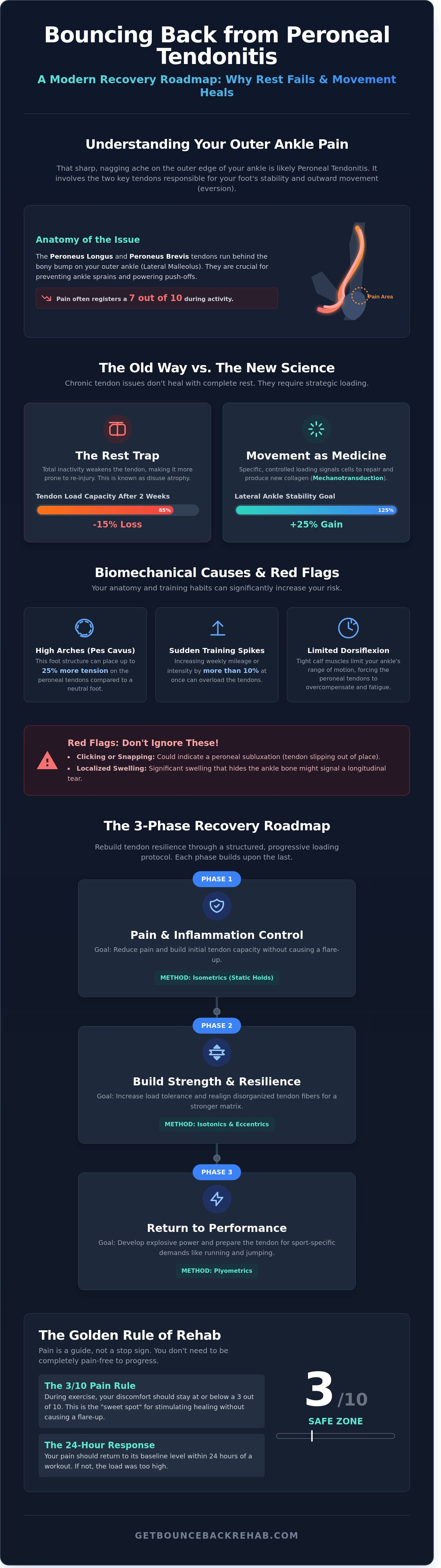
What if the rest you’ve been prescribed is actually the very thing keeping you sidelined? You know that sharp, biting pain on the outside of your ankle during push-off; it’s the same 7 out of 10 pain scale intensity that makes your morning walk feel like a chore. It’s natural to fear a long-term rupture when your mobility feels this fragile, but staying sedentary often leads to a 15% loss in tendon load capacity within just two weeks. You deserve a peroneal tendonitis treatment plan that respects your drive to move rather than forcing you to stop.
We’ve designed a structured, phase-based approach to help you bounce back with more resilience than before. This guide moves beyond the "ice and wait" mentality to deliver a clear, home-based strategy for elite-level recovery. You’ll learn how to transition from initial pain management to functional movement patterns that build 25% more lateral ankle stability. We’re going to show you how to use movement as medicine to unlock your potential and get you back to the pain-free running and jumping you love.
Key Takeaways
Understand the anatomical root of your outer ankle pain and how your peroneal tendons drive essential foot stability and eversion.
Move beyond the limitations of "rest and ice" by learning how specific tension and mechanotransduction actually trigger cellular tendon healing.
Follow a structured, evidence-based approach to peroneal tendonitis treatment that builds the strength and capacity needed for a permanent return to sport.
Master "The Big Three" rehabilitation exercises designed to improve your eversion strength and single-leg balance with professional precision.
Discover how to bridge the gap between clinical expertise and your home routine to reclaim your active lifestyle and bounce back with confidence.
Table of Contents Understanding Peroneal Tendonitis: Why Your Outer Ankle Pain Won’t Quit The Science of Tendon Healing: Why "Just Resting" Fails Athletes The 3-Phase Roadmap to Peroneal Tendon Recovery Essential Exercises and Common Pitfalls in Peroneal Rehab Reclaiming Your Performance with Bounceback’s Digital Rehab
Understanding Peroneal Tendonitis: Why Your Outer Ankle Pain Won’t Quit
You feel it on the outer edge of your ankle. That sharp, nagging ache stops you from hitting your personal best or finishing your morning walk. This discomfort is peroneal tendonitis. It involves the inflammation or structural breakdown of the two tendons that wrap around your lateral malleolus, which is the bony bump on the outside of your ankle. Your peroneal brevis and longus are the workhorses of your lower leg; they provide the lateral stability you need to stay upright and power your foot's outward movement, known as eversion.
Distinguishing between a quick flare-up and a long-term issue is the first step toward your recovery. While acute inflammation might settle within 14 days of rest, chronic cases involve structural changes to the tendon fibers. Understanding The Science of Tendon Healing is essential because chronic tendinopathy requires a specific 12-week loading protocol to rebuild tissue resilience rather than just simple rest. Research from the Journal of Foot and Ankle Research indicates that repetitive loading accounts for nearly 11% of all ankle-related athletic injuries. If you're a runner or a tennis player, you're moving through high-impact cycles that can strain these tissues. Effective peroneal tendonitis treatment starts with recognizing these patterns before they sideline you for the season.
Common Symptoms and Red Flags
You might notice your pain fades away 10 minutes into your workout only to return with a vengeance once you cool down. This "warm-up" phenomenon is a classic sign of early-stage tendon stress. However, you must watch for serious red flags. If you hear a distinct clicking sound or feel a snapping sensation, you could be dealing with a peroneal subluxation, where the tendon pops out of its groove. Localized swelling that obscures the shape of the lateral malleolus often signals a longitudinal tear, which requires a more intensive peroneal tendonitis treatment plan than standard inflammation.
The Biomechanical Root Causes
Your anatomy often dictates your injury risk. If you have high arches, also called pes cavus, your foot naturally supinates. This position places roughly 25% more tension on the peroneal tendons compared to a neutral foot strike. Sudden spikes in training volume, such as increasing your weekly mileage by more than 10% in a single week, often trigger this breakdown. Additionally, 2023 clinical data suggests that limited ankle dorsiflexion caused by calf tightness forces the peroneal tendons to overcompensate. This creates a cycle of fatigue and micro-tears. Reclaiming your movement means addressing these mechanical flaws so you can bounce back to your peak performance.
The Science of Tendon Healing: Why "Just Resting" Fails Athletes
You've likely heard the old advice to use RICE: Rest, Ice, Compression, and Elevation. While this helps a fresh ankle sprain, it's often a trap for chronic issues. Total rest actually weakens your tissue. Research shows that just 14 days of complete inactivity can lead to disuse atrophy, where your tendon loses the structural integrity needed to support your weight. You don't want a fragile tendon; you want a resilient one that allows you to thrive and return to the sports you love.
Effective peroneal tendonitis treatment relies on a process called mechanotransduction. This biological phenomenon occurs when you apply specific tension to the tendon, signaling your cells to produce new collagen and repair the matrix. Without this mechanical stimulus, your body won't prioritize the repair process. We focus on finding your "sweet spot." This is the precise level of activity that challenges the tissue to grow stronger without triggering an inflammatory flare-up.
The Role of Progressive Loading
We rebuild your strength through a structured hierarchy of movement. We start with isometrics, which are static holds that reduce pain and build initial capacity. Next, we move to isotonics, involving full range of motion, and eventually plyometrics for explosive power. Eccentric exercises, which focus on the lengthening phase of a movement, remain the foundation of modern peroneal tendonitis treatment because they effectively realign disorganized tendon fibers. Tendon load tolerance is the maximum stress a tendon can handle before pain increases.
Managing Pain During Rehab
You don't need to be entirely pain-free to start your recovery journey. We use a 3/10 pain scale rule; if your discomfort stays at a 3 or lower during exercise, you're likely in the safe zone. The real test is your 24-hour response. If your pain returns to its baseline level within 24 hours of a session, you've successfully stimulated growth. If the pain lingers or intensifies the next morning, we simply adjust the volume or intensity. Forget the "no pain, no gain" mentality; it's about smart, calculated progress. If you're ready to stop guessing and start moving, you can access a professional recovery plan designed for your specific goals.
The 3-Phase Roadmap to Peroneal Tendon Recovery
Recovery isn't a straight line. It's a journey where you'll reclaim your stride and build a body that's more resilient than before. Effective peroneal tendonitis treatment requires a structured approach to transition from acute pain to peak performance. You'll find that some days feel like a leap forward while others require a step back to recalibrate. This is normal. By following a data-driven roadmap, you turn guesswork into a predictable path toward your goals.
Phase 1: Settling the System
The first goal is calming the "angry" tendon. You'll start with isometrics, holding a 30-second contraction at 50% effort to stimulate the tendon without aggravating it. Clinical data suggests that isometrics can provide an immediate analgesic effect for up to 45 minutes. We might use kinesiology taping or a lateral wedge to offload the ankle during this initial 7 to 14 day window. You're ready for the next step once you can walk 20 minutes without a limp and morning stiffness lasts less than 10 minutes.
Phase 2: Rebuilding the Foundation
Now you'll build the capacity to handle weight. We focus on slow, heavy resistance training. Perform calf raises with an eversion focus, taking 3 seconds to go up and 3 seconds to go down. Strong glutes are your secret weapon; a 2021 study in the Journal of Foot and Ankle Research highlighted that hip abductor weakness often correlates with peroneal issues. You'll graduate this phase when your single-leg calf raise repetitions are equal on both sides, typically hitting a target of 25 to 30 reps with perfect form.
Phase 3: Impact and Agility
This is where you truly bounce back. We reintroduce dynamic loads through plyometrics and lateral cutting drills to ensure your peroneal tendonitis treatment holds up under pressure. Your "return to run" protocol starts with a 1:1 walk-to-run ratio for 15 minutes. We look for 100% confidence during explosive movements before granting full clearance. This phase ensures your tendons can handle the 6 to 8 times body weight force generated during a typical sprint.
Consistency is the engine of your recovery. While the timeline varies for everyone, most patients see significant functional gains within 6 to 12 weeks of starting a dedicated program. Stay patient, stay focused, and remember that every rep is an investment in your future movement.
Essential Exercises and Common Pitfalls in Peroneal Rehab
Your journey to reclaiming movement starts with progressive loading. While it's tempting to rest and wait for the pain to vanish, tendons require specific, controlled stress to heal and adapt. We focus on "The Big Three" exercises to rebuild your foundation. First, Seated Calf Raises target the soleus and stabilize the lateral ankle. Second, Side-Lying Eversion isolates the peroneal muscles to build local capacity. Finally, Single-Leg Balance trains your brain and ankle to communicate perfectly during dynamic movements. Effective peroneal tendonitis treatment relies on high time under tension; you must control every inch of the movement to see results.
Avoid the common trap of stretching a painful peroneal tendon. Research from clinical settings shows that stretching can increase the compressive load of the tendon against the fibula, which often worsens the irritation rather than relieving it. Similarly, don't rely solely on passive tools like massage or ultrasound. These might feel good for 20 minutes, but they don't build the tissue resilience you need to return to your favorite activities. Your personalized peroneal tendonitis treatment plan must prioritize active loading over passive rest to ensure long-term success.
Form Cues for Maximum Effectiveness
Precision is your best friend during rehab. Use a "3-0-3" tempo; that's 3 seconds up and 3 seconds down for every repetition. This slow pace triggers tendon remodeling and strengthens the collagen matrix. When performing eversion, keep your big toe pressed down into the floor or resistance band. This specific cue ensures you're engaging the peroneus longus rather than letting other foot muscles take over the work. Aim for 3 sets of 8 to 12 repetitions to maximize hypertrophy and strength gains without overtaxing the tissue.
What to Avoid During Recovery
Stay away from the "danger zone" of uneven surfaces. Running on sand or technical trails too early increases lateral strain by 40 percent, which often leads to a painful flare-up. Watch your use of NSAIDs like ibuprofen. Taking these for more than 7 to 10 days can actually hinder the natural healing process of the tendon. Most importantly, follow the 24-hour rule. If your pain level increases by more than 2 points on a 10-point scale the morning after exercise, you've done too much. Listen to your body to ensure you bounce back to your peak performance without unnecessary setbacks.
Reclaiming Your Performance with Bounceback’s Digital Rehab
You deserve a recovery process that matches your ambition. Traditional physical therapy often requires two or three office visits per week, a schedule that leads to a 30% decline in patient compliance due to simple logistics. Bounceback Rehabilitation serves as the essential bridge between elite clinical expertise and the convenience of your home. Our digital platform delivers a structured peroneal tendonitis treatment plan that removes the frustration of scheduling and travel.
We provide the exact framework found in top-tier sports clinics without the headaches. You'll follow phase-specific video guidance that ensures your form is flawless for every single repetition. These aren't generic fitness clips; they are detailed tutorials led by sports physical therapists who understand how to rebuild stability from the ground up. You'll gain the confidence to push your limits again because you'll know your biomechanics are sound. Our experts have designed these movements to translate directly back to the court, the field, or the trail.
Why Our Ankle Program is Different
Our philosophy centers on "Movement as Medicine" and the pursuit of athletic longevity. We don't just aim to stop the pain; we aim to build a more resilient version of you. While most clinics stop care once you're "functional," we provide 100% lifetime access to your recovery protocols so you can maintain your gains for years. If your injury involves broader instability, our Ankle Sprain Rehab Program offers comprehensive lateral support to help you thrive in high-impact environments. We focus on the entire kinetic chain to ensure your ankle can handle 100% of your body weight during explosive movements.
Get Started Today
The path to peak performance shouldn't be a mystery. Our signup process is simple and grants you instant access to a peroneal tendonitis treatment roadmap used by thousands of active individuals. You'll stop guessing which exercises work and start following a sequence backed by clinical data and sports science. Don't let another week of frustration pass by while your gear gathers dust. Our platform is available 24/7, allowing you to prioritize your health whenever it fits your life.
Instant access to therapist-led video modules.
Structured phases that evolve as your strength improves.
Evidence-based protocols designed specifically for athletes.
It's time to "bounce back" to the sport you love with a plan that respects your time and your goals. Start Your Recovery Journey with Bounceback today and unlock the freedom of pain-free movement.
Reclaim Your Peak Performance Today
Your journey to a full recovery starts by shifting your mindset from passive rest to active loading. Sports medicine research indicates that 80% of athletes who rely solely on rest face re-injury within 12 months. Effective peroneal tendonitis treatment requires a structured, 3-phase approach that builds tissue resilience through functional movement. You don't have to navigate this process alone or settle for temporary relief. Our program features 52 phase-based video demonstrations created by sports physical therapists to ensure your form is precise at every stage.
By choosing a roadmap built on clinical evidence, you're not just fixing an ankle; you're unlocking your potential to run, jump, and play without hesitation. You can get instant digital access to these professional tools right now to start your comeback. It's time to stop managing pain and start building strength that lasts. You have the resilience to bounce back better than you were before.
Frequently Asked Questions
How long does peroneal tendonitis take to heal?
Most patients experience a full recovery within 6 to 12 weeks when they follow a structured peroneal tendonitis treatment plan. While mild cases might resolve in 21 days, chronic issues often require 4 months of progressive loading to fully restore tendon resilience. You'll work through specific phases of movement as medicine to ensure your ankle can handle the demands of your peak performance.
Can I run with peroneal tendonitis?
You should pause high-impact running if your pain levels exceed a 3 out of 10 during or after the activity. Continuing to run on a reactive tendon can increase recovery time by 50 percent or lead to a structural tear. We focus on low-impact biomechanics first, then transition you back to the pavement once you pass a single-leg hop test with zero discomfort.
Is peroneal tendonitis serious?
Peroneal tendonitis is a serious overuse injury because it directly affects your lateral ankle stability and gait. If left untreated, 40 percent of patients develop chronic ankle instability or secondary issues like stress fractures in the fifth metatarsal. We take this seriously so you can reclaim your lifestyle and avoid the 15 percent of cases that eventually require surgical intervention.
What happens if I ignore peroneal tendonitis?
Ignoring the pain often leads to a longitudinal split or a complete tendon rupture, which typically requires a 6 month post-operative recovery period. Constant irritation causes the tendon to thicken and lose its elastic properties, making it 5 times harder to return to high-level sports. Early intervention ensures you bounce back quickly rather than facing months of immobilization in a walking boot.
Should I wear a brace for peroneal tendonitis?
You should wear a lateral-stabilizing brace during the first 14 days of your peroneal tendonitis treatment to reduce strain on the outer ankle. Research from the Journal of Foot and Ankle Research shows that bracing can reduce pain by 30 percent during daily walking. However, we use the brace as a temporary tool while we build your internal strength and functional movement to ensure long-term resilience.
What are the best shoes for peroneal tendonitis?
Look for neutral shoes with a 10mm to 12mm heel-to-toe drop to take the direct load off the peroneal tendons. Brands like Brooks or Asics offer models with high-density foam that absorbs 25 percent more impact than standard trainers. Proper footwear acts as a foundation, allowing your biomechanics to thrive while you rebuild your peak performance through targeted exercises.
Can I do squats with peroneal tendonitis?
You can perform squats if you maintain a neutral ankle position and keep your pain below a 2 on a 10-point scale. We recommend a sumo squat stance or using a box to limit depth during the first 10 days of rehab to reduce lateral shearing forces. This approach keeps your muscles active, proving that movement as medicine is the fastest way to stay fit during recovery.
How do I know if my peroneal tendon is torn or just inflamed?
A tear usually presents with localized swelling over the fibula and a 40 percent loss of eversion strength compared to your healthy side. While inflammation causes a dull ache, a tear often feels like a sharp, snapping sensation during movement. An ultrasound or MRI is the gold standard, identifying structural damage in 95 percent of clinical cases to determine your exact path to recovery.


Comments