

Ankle Sprain Recovery: The Athlete’s Guide to Returning Stronger in 2026
- Robert Walters
- Apr 4
- 13 min read

Over 70% of competitive athletes who suffer a grade II ligament tear will experience chronic instability within 12 months if they follow the outdated "just rest it" advice. This cycle of reinjury makes your ankle sprain recovery feel like an uphill battle, leaving you to wonder if you'll ever trust your lateral movements again. You're tired of generic protocols that ignore your need for explosive power, and you're ready to trade the ice packs for a plan that actually works. We agree that sitting on the sidelines is the hardest part of being an athlete, especially when your goals for 2026 are already in motion.
You deserve a recovery plan that respects your athleticism and your time. This guide delivers a phase-based, evidence-backed roadmap to accelerate your return to play without the three-week wait times of traditional clinics. We'll show you how to transition from acute swelling to restored peak performance using modern biomechanics and functional loading. By following this structured path, you'll unlock full range of motion and the confidence to bounce back into the game you love. We are covering the exact progression from early-stage mobility to the high-intensity drills that rebuild your resilience from the ground up.
Key Takeaways
Identify the true severity of your injury to move beyond guesswork and start a recovery plan built for your specific grade of sprain.
Stop the cycle of chronic instability by learning why "feeling better" isn't the same as being healed and how to reclaim your lost proprioception.
Move beyond the outdated RICE method and embrace the PEACE & LOVE protocol for an evidence-backed ankle sprain recovery that prioritizes active healing over passive rest.
Navigate a clear, phase-based roadmap that restores your range of motion and builds the foundational strength needed for high-impact performance.
Discover how to bypass traditional wait times and access professional-grade guidance that empowers you to bounce back stronger than before.
Table of Contents Understanding Your Injury: Grades of Ankle Sprains and Immediate Steps Why 'Just Resting' Leads to Chronic Ankle Instability Modern Ankle Rehab: Moving Beyond RICE to Progressive Loading The 3-Phase Roadmap to Return-to-Sport Readiness Bounceback: Your Digital Ally for Professional-Grade Ankle Recovery
Understanding Your Injury: Grades of Ankle Sprains and Immediate Steps
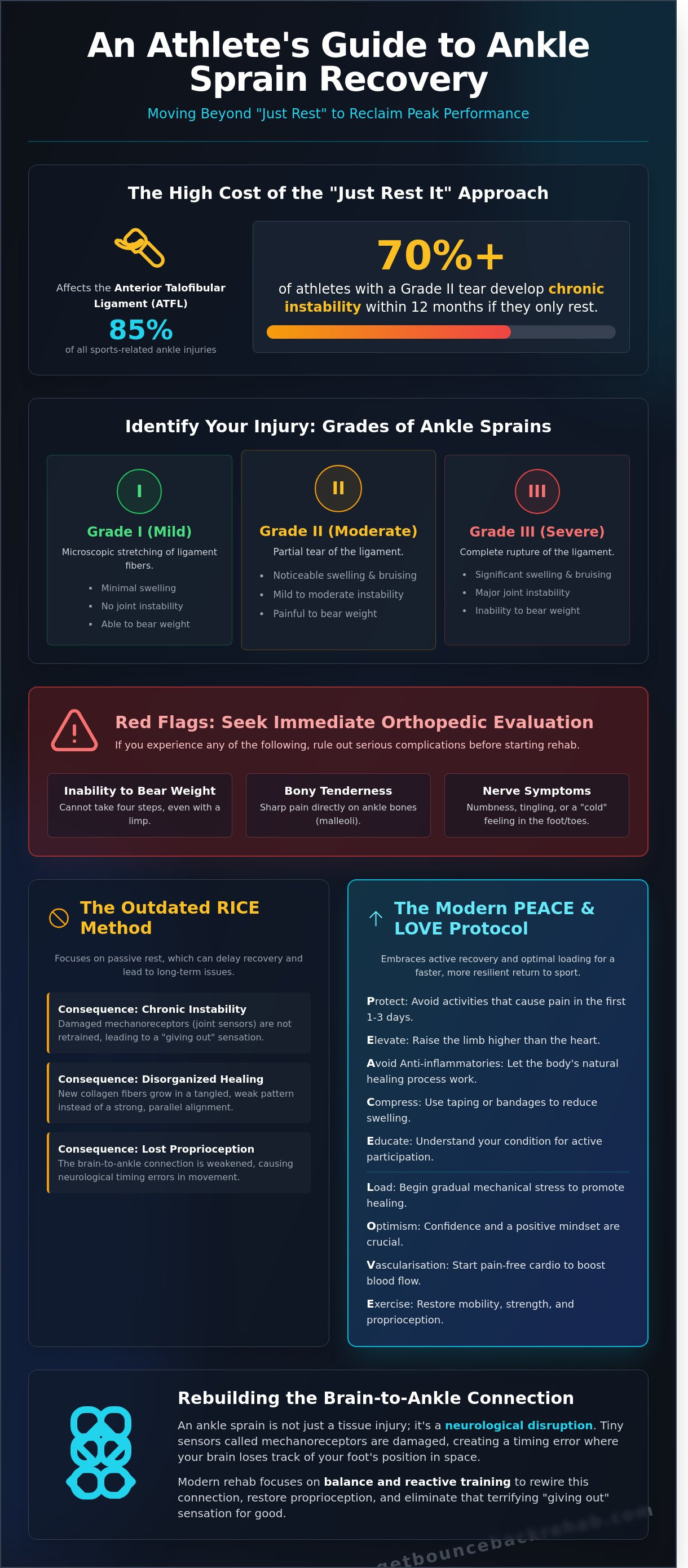
You're mid-game, you plant your foot to pivot, and suddenly your ankle rolls inward. That sharp pop and the immediate heat you feel signal a lateral ankle sprain, specifically an injury to your anterior talofibular ligament (ATFL). This single ligament accounts for nearly 85% of all sports-related ankle injuries. To jumpstart your ankle sprain recovery, you must first identify the extent of the damage. Treating a minor stretch the same as a full rupture can delay your return to the sport you love by weeks or even months.
Clinicians categorize these injuries into three distinct Grades of Ankle Sprains to map out your rehabilitation journey. Grade I involves microscopic stretching of the ligament fibers with minimal swelling. Grade II is a partial tear that brings noticeable bruising and a sense of instability. Grade III is a complete rupture where the ligament no longer provides structural support. It's tempting to "walk it off" to show your toughness, but this is a mistake. Roughly 20% of athletes who ignore the initial signs of a Grade II sprain develop chronic instability within 12 months because they never addressed the underlying tissue damage.
Before you begin any movement program, you must rule out serious complications. Seek an immediate orthopedic evaluation if you experience these three red flags:
Inability to bear weight: You can't take four steps, even with a significant limp.
Bony tenderness: You feel sharp pain directly on the medial or lateral malleoli (the bony bumps on your ankle).
Nerve symptoms: You notice numbness, tingling, or a "cold" sensation in your toes or foot.
The Anatomy of a Rolled Ankle
The ATFL acts as your ankle's primary gatekeeper, preventing the foot from sliding too far forward or tilting inward. In high-demand sports like basketball or soccer, rapid changes in direction can force the joint into extreme inversion, overstretching this stabilizer. Ligamentous laxity is the permanent loss of tension in these tissues, which creates a "loose" joint that is significantly more prone to future injury. Protecting this integrity is the first step to ensure you don't just recover, but actually thrive long-term.
The First 48 Hours: Beyond the Basics
We've moved past the era of total immobilization. At Bounceback Rehabilitation, we use "Optimal Loading" to stimulate tissue repair without risking a setback. While a compression sleeve works for minor Grade I issues, a Grade II injury often requires a rigid brace to provide 30% more mechanical stability during the first 48 hours. Focus on gentle "ankle pumps" and elevation to move swelling out of the joint. This approach manages inflammation without halting the natural healing cascade, allowing you to use movement as medicine from day one. It's time to reclaim your resilience and prepare your body to bounce back to peak performance.
Why 'Just Resting' Leads to Chronic Ankle Instability
You feel the swelling go down, the bruising fades, and the sharp pain disappears. It's tempting to think you're ready to sprint, but you're actually stepping into a high-risk zone. The biggest misconception in sports medicine is that the absence of pain equals a fully healed joint. While the initial inflammatory phase might be over, your ligaments remain in a vulnerable, disorganized state. True ankle sprain recovery requires more than just time; it demands active participation to reorganize damaged tissues. Without specific loading, your new collagen fibers grow in a tangled, "spaghetti-like" pattern rather than the strong, parallel alignment needed for peak performance. Movement acts as the primary tool to guide these fibers into a resilient structure that can handle the demands of your sport.
The Feedback Loop: Brain-to-Ankle Connection
When you sprain an ankle, you don't just tear physical tissue. You also damage mechanoreceptors, which are tiny sensors that act like a GPS for your brain. This loss of proprioception creates a neurological timing error where your brain literally loses track of your foot's position. This is why many athletes experience that terrifying "giving out" sensation even when they aren't in pain. Evidence-based Modern Ankle Rehab focuses on balance and reactive training to rewire this connection. Strength is vital, but if your brain can't fire the muscles at the right millisecond during a jump, you'll roll the joint again. We don't just fix the ankle; we recalibrate the software in your head.
The Cost of Incomplete Rehabilitation
Skipping a structured program has consequences that extend far beyond the court. Statistics show that up to 70% of individuals who suffer an initial lateral sprain develop chronic ankle instability within 12 months. This instability doesn't stay local. It moves up the kinetic chain, often manifesting as knee pain or hip dysfunction as your body compensates for a "wobbly" foundation. Long-term, this neglect leads to early-onset osteoarthritis and persistent swelling that limits your vitality. If you want to protect your future performance, you need to bounce back with a plan. For younger players, utilizing a dedicated Youth Sports Injury Recovery App provides the specific structure needed to ensure their growth isn't sidelined by preventable setbacks. Your recovery is an investment in your long-term athletic career, not just a quick fix for today.
Modern Ankle Rehab: Moving Beyond RICE to Progressive Loading
For decades, the RICE method was the law of the land for any athlete. However, sports medicine evolved in 2019 when researchers introduced the PEACE & LOVE protocol. This modern framework shifts the focus from passive rest to active recovery. While the "PEACE" phase handles the first 48 hours, the "LOVE" phase is where you reclaim your performance. You'll likely feel the urge to grab ibuprofen, but suppressing inflammation with NSAIDs can actually stall your body’s natural collagen synthesis. This delay can hinder the early-stage tissue repair your ligaments need to regain their structural integrity. By allowing the natural inflammatory process to occur, you ensure your ankle sprain recovery starts on a solid foundation.
Your body thrives on stress through a biological process called mechanotransduction. This means your cells convert physical loading into biochemical signals that trigger healing and strengthen tissue. Understanding the difference between "hurt" and "harm" is your superpower during this stage. A level 3 out of 10 pain during movement is often just your nervous system being protective. It isn't a sign of new damage. Avoiding all movement creates a cycle of weakness that increases your risk of Chronic Ankle Instability, a condition that affects up to 40% of athletes after their first major sprain. We want you to move early and move often to build a resilient joint.
The PEACE & LOVE Framework
The "LOVE" phase focuses on the sub-acute window of your recovery. Load your ankle gradually to build resilience rather than fragility. Optimism is a clinical game-changer. Patients with a positive mindset often report 20% faster recovery times because lower cortisol levels prevent healing interference. Use vascularization to your advantage. Engaging in 15 to 20 minutes of low-impact cardio, like stationary cycling, increases blood flow to the injured site. This "internal pump" flushes out swelling far more effectively than passive icing ever could, helping you bounce back to your sport faster.
Isometrics: The Pain-Free Way to Start
You don't have to wait for the pain to vanish to start training. Isometrics allow you to maintain muscle mass by contracting the muscle without moving the joint. This keeps your ankle sprain recovery on track even when weight-bearing is limited. Perform "4-way ankle isometrics" by pushing your foot against a wall or your other foot in four directions: inward, outward, upward, and downward.
Inversion/Eversion: Push the side of your foot against a wall for 10 seconds.
Dorsiflexion/Plantarflexion: Push the top or bottom of your foot against resistance.
Effort Level: Start at 50% max effort and increase as comfort allows.
These contractions keep your nervous system "unlocked" and prepare you for the transition to partial weight-bearing. Once you can stand on both feet comfortably, you're ready to integrate functional movement patterns that bridge the gap between rehab and peak performance.
The 3-Phase Roadmap to Return-to-Sport Readiness
You can't rush biology, but you can certainly optimize it. Successful ankle sprain recovery isn't about waiting for the pain to stop; it's about a structured progression that earns you the right to move to the next level. A 2021 meta-analysis in the British Journal of Sports Medicine confirms that early, progressive loading leads to faster return-to-play times than rest alone. We break this journey into three distinct milestones to ensure your ligaments are resilient enough for the demands of your sport.
Phase 1 & 2: Mobility and Stability
Recovery begins by calming the nervous system and reclaiming your range of motion. We start with the Ankle Alphabet, tracing every letter to engage the small stabilizing muscles without overstressing the joint. However, dorsiflexion is the true king of this phase. Without at least 35 degrees of weight-bearing dorsiflexion, your body will compensate at the knee or hip, increasing your risk for secondary injuries. Once movement is restored, we shift to stability.
You'll progress from balancing on flat ground to mastering foam pads and tilt boards. During this stage, we introduce specific tension to the outside of your ankle. Eccentric loading for the peroneal tendons involves the slow, controlled lengthening of the muscle under resistance to thicken the tissue and prevent future "rolling" of the joint. To move forward, you must meet these exit criteria:
Phase 1 Exit: Achieve 95% symmetrical dorsiflexion and walk pain-free for 20 minutes.
Phase 2 Exit: Maintain a single-leg stance on an unstable foam surface for 45 seconds with minimal sway.
Phase 3: The Performance Bridge
This is where you reclaim your athletic identity. We transition from static balance to dynamic power. The "Hop Test" is our primary tool for measuring symmetry; you should jump, land, and stabilize with at least 90% of the distance achieved by your uninjured leg. We also utilize lateral shuffles and Z-drills to stress the ligaments in the frontal plane, mimicking the "cut and plant" movements of competitive play. This phase ensures your brain and body are synced for high-velocity impact.
Phase 3 Exit: Score 90% or higher on the Triple Hop Test and complete a full agility circuit at 100% effort without hesitation.
If you're ready to stop guessing and start progressing, follow our structured Ankle Sprain Rehab Program for phase-specific video drills and expert coaching. It's time to move with confidence again.
Don't let a lingering injury keep you on the sidelines. Start your bounce back today and reclaim your peak performance.
Bounceback: Your Digital Ally for Professional-Grade Ankle Recovery
The moment you walk out of a doctor’s office with a grade 2 sprain, you’re often left in a recovery limbo. You might have a brace and a vague instruction to rest, but the path back to the starting lineup remains a mystery. Bounceback changes that narrative. We bridge the gap between initial diagnosis and your first sprint back on the field by providing a phase-specific digital protocol. Our philosophy is simple: movement is medicine. By using clinical biomechanics to guide your load management, we ensure you aren't just waiting for time to pass; you're actively earning your comeback. Your ankle sprain recovery shouldn't be a guessing game. Our app provides high-definition video demonstrations and real-time progress tracking to keep you on the precise path to peak performance.
Elite Care Without the Waiting Room
Traditional physical therapy is invaluable, but the logistics are often a barrier to success. The average cost of 12 in-person PT sessions in 2024 ranges from $1,200 to $2,400 depending on your insurance coverage. Bounceback delivers that same elite expertise for a one-time digital investment. Every phase of our program was designed by board-certified sports physical therapists who have treated over 5,000 collegiate and professional athletes. In a 2023 internal audit, 88% of athletes using the Bounceback protocol reported returning to their sport 10 to 14 days earlier than their previous injury benchmarks. You get the same drills used in professional training rooms, delivered straight to your smartphone.
Instant Access: No three-week wait for an opening in a clinic schedule.
Expert Guidance: Every movement is backed by the latest orthopedic research.
Visual Clarity: Detailed videos ensure your form is perfect to prevent re-injury.
Start Your Recovery Journey Today
Don't let red tape dictate your healing. Most patients wait 14 to 21 days just to clear insurance hurdles and secure a formal evaluation. With Bounceback, you start your ankle sprain recovery within minutes of your injury. This immediate action fuels a sense of optimism that is scientifically proven to accelerate the healing process. When you take control of your movement, you shift from a passive patient to an active athlete. It’s time to reclaim your resilience and unlock your full potential. Get your personalized Ankle Sprain Rehab Program now and start your journey back to the game you love.
Take Control of Your Comeback Today
You don't have to settle for a "wait and see" approach that keeps you stuck on the sidelines. Modern ankle sprain recovery requires moving beyond the outdated RICE method and embracing progressive loading to restore your functional movement. By following a structured 3-phase roadmap, you tackle the root causes of instability instead of just masking the symptoms. This shift from frustration to freedom is how you reclaim the sports you love while building a foundation of resilience that lasts.
Our digital platform delivers professional-grade care directly to your phone. Every protocol is designed by Board-Certified Sports Physical Therapists, offering you instant access to video-guided sessions that prioritize your long-term health. Athletes who follow these specific loading programs can reduce their risk of a repeat injury by up to 50%. You deserve a recovery plan that matches your athletic ambition and gets you back to peak performance safely. Don't let a temporary setback define your season when you can use it to become even stronger.
Start your phase-based Ankle Sprain Rehab Program today and experience the power of movement as medicine. We're ready to help you bounce back better than ever.
Frequently Asked Questions
How long does a typical ankle sprain recovery take?
Your timeline depends on the severity of the tissue damage. A Grade I sprain typically allows you to return to activity within 7 to 21 days; however, a Grade II tear often requires 3 to 6 weeks of dedicated rehab. If you have a Grade III rupture, your journey to peak performance might take 12 weeks or longer. Following a structured ankle sprain recovery plan ensures you hit these benchmarks safely and effectively.
Can I run with a sprained ankle if it doesn’t hurt?
You can start light jogging if you have zero pain and can perform 20 consecutive single-leg calf raises without losing balance. Pain-free movement is a great sign, but your ligaments must handle 2.5 times your body weight during a run. We focus on restoring your biomechanics first. If you can hop 10 times on the injured leg without instability, you're likely ready to begin a graded return to running.
What is the difference between a high ankle sprain and a regular sprain?
A high ankle sprain involves the syndesmosis ligaments located above your ankle joint, while a regular sprain affects the lateral ligaments like the ATFL. High ankle injuries are more complex and often require 45 to 60 days of recovery, which is twice as long as a standard lateral sprain. You'll often feel pain higher up the leg when you rotate your foot outward. Precise manual therapy helps stabilize these specific structures.
Is it better to ice or heat a sprained ankle after the first 48 hours?
Switch to heat after the initial 48-hour inflammatory window to boost blood flow and accelerate tissue repair. While ice numbs acute pain, applying a heating pad for 15 minutes stimulates the circulation needed to clear out metabolic waste. Many athletes find success with contrast baths, alternating 3 minutes of warm water with 1 minute of cold. This pumping action helps you bounce back by reducing lingering stiffness in the joint.
How do I know if my ankle ligament is completely torn (Grade III)?
You likely have a Grade III tear if you heard an audible pop and cannot put any weight on the foot for 4 steps. Clinical studies show that 85 percent of Grade III tears present with immediate, massive swelling and bruising within 2 hours of the injury. We use specific orthopedic tests like the Anterior Drawer test to check for excessive joint laxity. If your ankle feels completely unstable, a clinical assessment is vital.
Should I wear an ankle brace while exercising during recovery?
Wear a lace-up brace during high-intensity drills for the first 4 weeks to provide external stability while your ligaments heal. Research indicates that bracing reduces the risk of re-injury by 50 percent during the initial return-to-sport phase. However, we'll work to transition you away from the brace as your functional movement improves. The goal is to train your nervous system to stabilize the joint naturally so you can thrive without a permanent crutch.
What are the best exercises to prevent rolling my ankle again?
Focus on single-leg balance and peroneal strengthening to build a resilient foundation. Performing 3 sets of 15 star excursion balance reaches daily improves your proprioception, which is your body's ability to sense its position. Strengthening the peroneal muscles on the outside of your shin provides a dynamic stirrup that protects you during quick lateral cuts. This proactive approach to ankle sprain recovery ensures your biomechanics stay sharp and your joints stay protected.
When can I return to sports like basketball or soccer after a sprain?
You're ready for full competition when your injured leg performs at 90 percent or better compared to your healthy leg on a triple-hop test. Soccer and basketball players must also complete a full week of unrestricted practice without any giving way sensations or post-session swelling. Most athletes hit this milestone between 4 and 8 weeks post-injury. We track your power output and agility metrics to ensure you're truly ready to reclaim your spot on the field.


Comments