

ACL Injury Length of Recovery: The Milestone-Based Timeline for Athletes
- Robert Walters
- Apr 5
- 13 min read

Research published in the British Journal of Sports Medicine reveals that 25 percent of athletes under age 25 who return to pivoting sports will suffer a second tear. This statistic is sobering when you're already navigating the frustration of limited mobility and wondering about the actual acl injury length of recovery. You want to know when you can stop being a patient and start being an athlete again, but you're worried that rushing back will lead right back to the operating table. It's time to stop measuring your progress by the months on a calendar and start measuring it by the resilience of your movement.
We're going to give you the exact roadmap you need to beat the odds and reclaim your lifestyle. This guide replaces the "wait and see" approach with a high-performance strategy that focuses on functional milestones rather than just the passage of time. You'll learn how to transition from basic rehab to peak performance with a clear, predictable plan. We'll preview the essential phases of recovery that allow you to bounce back with more power and stability than you had before your injury.
Key Takeaways
Understand why the acl injury length of recovery is a variable window of 6-12 months driven by your unique biology rather than just the calendar.
Master the five distinct phases of rehabilitation to ensure you build a resilient foundation and avoid the risks of skipping critical steps.
Learn why functional milestones and objective testing are more reliable indicators for a safe return to sport than your surgery date alone.
Identify the specific lifestyle and training variables you can control to optimize your timeline and unlock your peak performance.
Discover how to bypass the traditional physical therapy waiting room and start your professional, phase-specific recovery protocol today.
Table of Contents The Reality of ACL Injury Length of Recovery: Why Time is Only Half the Story The 5 Phases of ACL Rehabilitation: A Step-by-Step Roadmap Milestones Over Months: Critical Criteria for Returning to Play Factors That Accelerate (or Delay) Your ACL Recovery How to Start Your Professional ACL Recovery Protocol Today
The Reality of ACL Injury Length of Recovery: Why Time is Only Half the Story
The moment you hear that pop, your first question is almost always: "When can I get back?" It's a natural reaction because you want your lifestyle back. However, the acl injury length of recovery isn't a single date you circle on your calendar. It's a variable window that typically spans 6 to 12 months. This timeframe isn't just about waiting for a ligament to tighten; it's about the intersection of your unique biology and your daily effort.
You must understand that biological healing and functional rehab move at different speeds. Your body might repair tissue at a cellular level within 12 weeks, but your brain and muscles require much longer to regain the 90% limb symmetry required for safe, explosive movement. Many athletes mistakenly assume surgery is a "reset button" that fixes the knee instantly. In reality, surgery only provides the structural hardware. High-quality rehabilitation is the software that actually runs the system. Without focused training, a new ligament is simply a piece of tissue inside a weak, uncoordinated limb.
We often see a phenomenon called "The Bounceback Gap." This is the critical 14 to 21-day period between your initial injury and the moment you start professional guidance. If you spend those three weeks sitting on the couch waiting for swelling to subside without a structured plan, you're losing ground. You need to use movement as medicine from day one to protect your muscle mass and maintain joint range of motion. Closing this gap is the first step toward a successful return to the activities you love.
The 9-Month Rule vs. Individual Readiness
Clinical research, including a landmark 2016 study by Grindem, shows that for every month you delay returning to sport up until the 9-month mark, your risk of re-injury drops by 51%. This 9-month window is the clinical gold standard for graft maturation. If you choose an autograft using your own hamstring or patellar tendon, your body must "ligamentize" that tissue over several months. Allografts, or donor tissue, often require 12 or even 18 months to reach peak biological strength. Remember, being pain-free is not a green light for high-impact sports. You need objective strength data to prove you're ready.
Non-Surgical vs. Post-Surgical Timelines
Choosing a non-surgical path doesn't mean you're taking a shortcut. It requires a massive commitment to neuromuscular control and balance. While some athletes return to linear activities like jogging in 12 to 16 weeks, The Non-Surgical ACL Recovery Timeline requires hitting specific functional milestones to ensure long-term stability. Medical literature distinguishes between "Copers" and "Non-Copers." Roughly 40% of patients are "Copers" who can stabilize their knee through muscle activation alone. If you're a "Non-Coper," your knee may feel unstable despite high strength levels, which often influences the acl injury length of recovery and the eventual need for surgical intervention.
The 5 Phases of ACL Rehabilitation: A Step-by-Step Roadmap
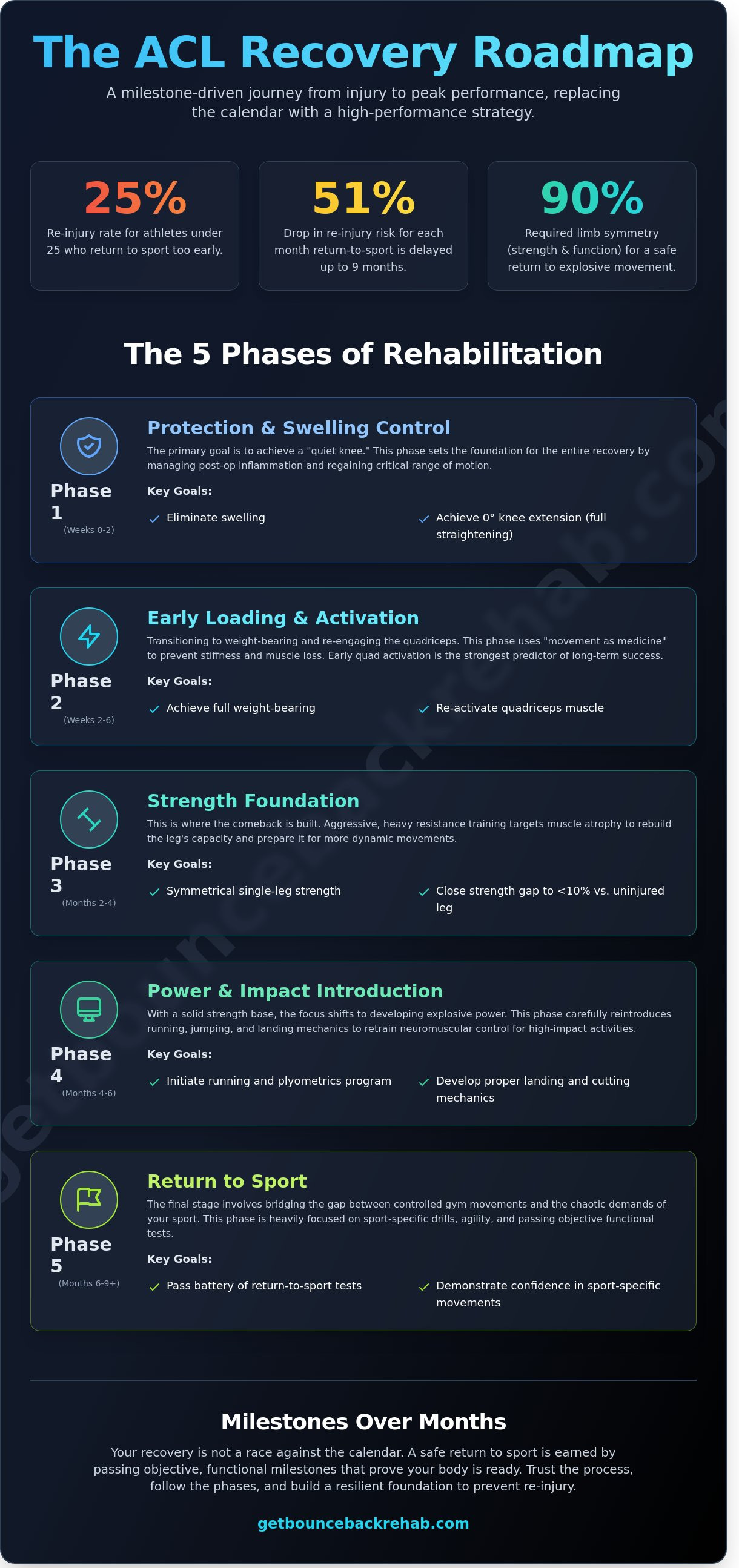
Think of your recovery as an elite athletic training program rather than a medical chore. You're leveling up through a series of specific performance gates. Skipping a phase or rushing the process isn't just a shortcut; it's a gamble that spikes your re-injury risk by up to 15 percent for every month you cut from the timeline. Bounceback's ACL Rehab Program is built specifically around these objective milestones to ensure your knee is resilient enough for the next challenge.
Phase 1 & 2: Protection and Early Loading
Phase 1 focuses on the "quiet knee." Your top priority is eliminating swelling and hitting 0 degrees of knee extension. Regaining full straightening early is the most critical goal of your entire journey. If you miss this window, you risk permanent gait changes. Phase 2 introduces "movement as medicine" to prevent joint stiffness. You'll transition to full weight-bearing and focus on re-activating the quadriceps muscle. Research shows that early quad activation is the strongest predictor of long-term success in your acl injury length of recovery.
Phase 3 & 4: Strength, Power, and Impact
Strength is the foundation of your comeback. Phase 3 utilizes heavy resistance training to aggressively target muscle atrophy. Your goal is to close the strength gap until your injured leg is within 10 percent of your healthy side. Phase 4 introduces "Return to Run" protocols and low-level plyometrics. Plyometrics are explosive movements that bridge the gap between strength and sport. These movements teach your nervous system to absorb force safely, which is a vital component in shortening the overall acl injury length of recovery without compromising safety.
Phase 5: Return to Sport and Performance
The final level focuses on the psychological transition from patient back to athlete. You'll master sport-specific drills, cutting, pivoting, and reactive agility. It's about moving with confidence rather than caution. Even after you receive full clearance, the journey doesn't stop. Data suggests that athletes who maintain a strength program for 24 months post-injury have significantly lower secondary tear rates. You've worked hard to reclaim your lifestyle; a consistent maintenance routine keeps that progress locked in.
Ready to start your journey with a plan built for athletes? You can explore our specialized remote coaching to ensure you hit every milestone with precision.
Milestones Over Months: Critical Criteria for Returning to Play
Your recovery isn't a countdown; it's a climb. While most people define the acl injury length of recovery by the number of months passed, elite results depend on objective data. If your doctor cleared you at six months based on a simple physical exam, you're missing the full picture. Biology doesn't follow a calendar. Data from a 2016 study in the British Journal of Sports Medicine shows that for every month you delay returning to sport up to nine months, your risk of re-injury drops by 51%. Returning too early is a gamble you don't need to take. We use the Limb Symmetry Index (LSI) to ensure your injured side is within 90% of your healthy side before you ever consider a pivot.
To unlock your full potential and bounce back with confidence, you must pass a battery of functional tests. These aren't just suggestions; they're non-negotiable requirements for anyone wanting to avoid the operating room. You should achieve a 90% LSI across these specific movements:
Single leg hop for distance: Testing explosive power and landing stability.
Triple hop for distance: Measuring your ability to generate force consecutively.
6-meter timed hop: Assessing your speed and dynamic control under fatigue.
Crossover hop: Evaluating your knee's stability during lateral stress.
The Quadriceps Strength Benchmark
Achieving 90% or greater quad symmetry is the single biggest predictor of a successful return to your lifestyle. Your brain often "shuts down" the quad after an injury to protect the joint, a process known as arthrogenic muscle inhibition. You must reconnect that circuit to ensure your acl injury length of recovery stays on track. Try this at home: perform a single-leg sit-to-stand test from a standard chair. If you can perform 20 reps on your healthy leg but only 12 on your injured leg, your "movement as medicine" plan needs more focus on isolated strength before you hit the field.
Psychological Readiness: The ACL-RSI Scale
Physical strength is only half the battle. Kinesiophobia, or the fear of movement, often lingers long after the tissue has stabilized. This mental lag can cause you to hesitate during a game, leading to poor biomechanics and new injuries. We use the ACL-Return to Sport after Injury (ACL-RSI) scale to quantify your confidence. If your score is below 60, your mind isn't yet in sync with your body. We treat your mindset like a muscle; we build it through graded exposure and structured mental milestones so you feel empowered, not anxious, when you finally return to the activities you love.
Factors That Accelerate (or Delay) Your ACL Recovery
Your recovery isn't just a passive wait for a ligament to knit back together. It's an active, daily investment in your future performance. While biology has its own pace, you hold the remote control for the speed and quality of your results. Your acl injury length of recovery is often a reflection of how well you manage variables like sleep, nutrition, and psychological stress. When you prioritize these pillars, you create an internal environment where your body can thrive rather than just survive.
Nutrition provides the literal building blocks for tissue repair. Aiming for 1.6 to 2.2 grams of protein per kilogram of body weight ensures your muscles have the fuel to grow and support the joint. Sleep is equally vital; getting less than 7 hours of rest can increase your injury risk and slow down cellular regeneration. For youth athletes, the stakes are even higher. Because their growth plates are still open, a rushed return to sport can lead to long-term skeletal complications. Patience is a performance metric, and respecting these biological boundaries is how you ensure a lifelong return to movement.
Pre-hab: The Secret to a Faster Post-Op Recovery
Starting your rehabilitation immediately after injury sets a powerful foundation. Research shows that patients who engage in 5 weeks of pre-hab see a 20% improvement in functional outcomes after the initial healing phase. You can start reclaiming your range of motion and "waking up" your quad muscles with these safe movements:
Quad Sets: Squeeze your thigh muscle tight against the floor for 10 seconds to combat muscle wasting.
Heel Slides: Gently pull your heel toward your glutes to restore flexion without stressing the ligament.
Ankle Pumps: Move your feet up and down 20 times to keep circulation moving and reduce swelling.
Understanding these early milestones helps you recognize Key Signs Your ACL Is Healing Correctly Without Surgery as you build momentum toward your goals.
Common Pitfalls: Why Some Timelines Stretch to 18+ Months
Even the best plans can hit speed bumps. A "cyclops lesion," which is a small ball of fibrous tissue, can physically block your knee from straightening. This occurs in about 1% to 10% of cases and often requires a professional adjustment to the protocol. However, the most common delay is inconsistent rehab. Missing just two sessions a week can lead to a 30% slower strength gain, turning a 9 month journey into an 18 month struggle. Don't let "ego-lifting" or trying to jump back into a pickup game too soon derail you; persistent swelling is a signal from your body to scale back. If you stay consistent and listen to the data, you'll optimize your acl injury length of recovery and reclaim the lifestyle you love.
Ready to take the first step toward a stronger knee?
How to Start Your Professional ACL Recovery Protocol Today
You shouldn't have to put your life on hold while waiting for an insurance authorization or a gap in a clinic's schedule. The traditional physical therapy model often forces athletes into a "waiting room" limbo, where the first 14 days of crucial early-stage rehab are frequently lost. This delay can significantly extend your acl injury length of recovery, turning a manageable setback into a frustratingly long ordeal. Bounceback eliminates these barriers by providing immediate, elite-level guidance the moment you're ready to work. We've combined clinical biomechanics with the high-energy motivation of a personal coach to ensure you never feel lost in your rehabilitation journey.
Our digital, phase-specific program follows you anywhere, whether you're at the gym, at home, or traveling for work. We believe in movement as medicine, and our "Supportive Expert" approach ensures you have the precision of a doctor with the heart of a teammate. You don't need to wait for an appointment to start your comeback. You can begin reclaiming your mobility and strength right now, using a structured path that has been proven to help athletes return to the sports they love.
Instant Access to Elite-Level Sports Rehab
Accessing top-tier sports rehab shouldn't require a professional athlete's contract. The Bounceback platform delivers high-definition video demonstrations and real-time progress tracking directly to your smartphone. Consider the financial reality of traditional care: the average ACL rehab requires 40 to 60 clinical visits. With specialist co-pays often reaching $50 per session, you're looking at $2,000 to $3,000 in out-of-pocket costs alone. A one-time digital purchase provides the same phase-specific protocols for a small fraction of that investment. Plus, you receive lifetime access, which serves as a permanent resource for injury prevention and maintaining peak performance long after your initial recovery is complete.
Join a Community of Resilient Athletes
Recovery is a mental game as much as a physical one, and isolation is the enemy of progress. When you follow our structured protocol, you're joining a community of resilient athletes who refuse to let an injury define their future. We've designed this program to help you transition from limitation to total freedom. Our brand promise is simple: we want you fixed, thriving, and back to your peak. We don't just help you walk; we help you rebuild the explosive power and confidence that define your athletic identity. Don't let your acl injury length of recovery be dictated by a slow-moving healthcare system. Take control of your movement and start your transformation today.
Take the first step toward your peak performance:
Own Your Comeback with Milestone-Based Training
Your journey back to the field isn't defined by a static date on the calendar. While the typical acl injury length of recovery ranges from 9 to 12 months, your ultimate success depends on mastering the 5 critical phases of rehabilitation. Clinical research shows that achieving 90% limb symmetry is the gold standard for a safe return to play. By focusing on objective milestones instead of just counting weeks, you reduce your risk of re-injury and build the functional movement patterns needed for peak performance.
You don't have to navigate this complex roadmap alone. Our phase-specific protocols, developed by elite sports physical therapists, offer the clinical precision required to reclaim your active lifestyle. You'll gain instant digital access to structured workouts, ensuring you never miss a beat in your progress. We focus on the biomechanics that matter most, helping you transition from frustration to total freedom. It's time to stop settling for a slow recovery and start training for your best season yet.
Unlock Your ACL Recovery Roadmap Today and join a community dedicated to your resilience. You've got the heart to win; we've got the map to get you there. Let's start your movement as medicine journey right now.
Frequently Asked Questions
How long does it take to walk normally after an ACL tear?
You can typically expect to walk without a limp or assistive devices within 2 to 4 weeks after the initial injury. This timeline depends on your ability to reduce swelling and regain full knee extension, which is the 0-degree mark of a straight leg. Our goal is to restore your natural gait pattern quickly so you can reclaim your daily freedom and start the next phase of your movement journey.
Can I shorten my ACL recovery time with more intense exercise?
You can't rush the biological healing process because your body requires a specific physiological window to stabilize the knee joint. While high-intensity effort is vital for muscle growth, pushing too hard too soon can increase inflammation and delay your progress by 3 to 6 weeks. We focus on optimal loading rather than maximum intensity to ensure your acl injury length of recovery remains on track without any unnecessary setbacks.
What happens if I don’t do physical therapy after an ACL injury?
Skipping professional rehabilitation increases your risk of secondary meniscus tears by 40% within the first two years. Without guided functional movement training, your quadriceps may remain 20% weaker than your uninjured side; this leads to chronic instability and early-onset osteoarthritis. We use evidence-based protocols to bridge the gap between feeling okay and achieving peak performance, ensuring your knee is resilient enough for any future challenge you face.
Is it possible to return to sports in 6 months after ACL surgery?
While some athletes attempt a 6-month return, research published in the British Journal of Sports Medicine shows that waiting until the 9-month mark reduces re-injury risk by 51% for every month delayed. Returning too early often results in a 25% chance of a second tear. We prioritize your long-term athletic career, using objective strength testing to ensure you're truly ready to thrive on the field again with total confidence.
How much does an online ACL rehab program cost compared to traditional PT?
Online ACL programs typically cost between $150 and $300 per month, whereas traditional in-person sessions can range from $100 to $250 per visit. If you attend physical therapy twice a week, you might spend over $1,000 monthly. Our hybrid approach combines the clinical precision of expert oversight with the flexibility of digital tracking; this makes elite-level care accessible and cost-effective for your specific lifestyle and recovery goals.
Can youth athletes recover faster from an ACL injury than adults?
Youth athletes don't necessarily recover faster; in fact, patients under age 20 face a 30% higher risk of re-injury compared to older adults. While younger bodies have high cellular turnover, their skeletal maturity and biomechanical control require specialized attention. We focus on neuromuscular training to help young stars bounce back with better movement patterns than they had before the injury occurred, ensuring they stay on the court longer.
What are the signs that my ACL recovery is behind schedule?
You're likely behind schedule if you cannot achieve full 0-degree knee extension by the 4-week mark or if swelling persists after 6 weeks of rehab. Another red flag is a 20% or greater strength deficit between your legs during functional testing at the 3-month milestone. Monitoring the acl injury length of recovery through these specific data points allows us to adjust your program and unlock your full physical potential.
Do I need a brace during the entire length of my ACL recovery?
You typically won't need a brace for the entire duration, as most protocols phase them out between weeks 2 and 6. Once you demonstrate 80% of your baseline quadriceps strength and stable single-leg balance, the brace often becomes unnecessary for daily activities. We view movement as medicine, transitioning you away from external supports so your own muscles provide the elite-level stability and power your knee requires to function.


Comments